India Inflation Watch

By Inflation Watch

Consumer Inflation rose in April to 8.59%. The elevated inflation levels could pressure on the central bank to keep interest rates at current levels despite pressure from Indian industry to bring them down.

The RBI wants to see consumer inflation ease to 8% by January 2015 and 6% in the following year.

The country’s wholesale price index likely rose 5.80% in April from a year earlier, according to a poll of 12 economists by The Wall Street Journal. The index increased 5.70% in March, which was its fastest rise in three months. The government is scheduled to announce the rate on Thursday.

Food prices rose during the month as vegetable and fruit supplies from a bumper crop earlier in the year dried up. Lower fuel prices helped offset some of the higher food prices, economists said. Indian fuel retailers lowered gasoline prices twice in April.

For the rest of this year economists and weather watchers are worried that below-normal rains during the June through September monsoon season could trigger inflation again.

(Source: Wall Street Journal)

China’s Inflation Slows More Than Estimated

By Inflation Watch

Consumer inflation in China moderated to an 18-month low and the decline in factory-gate prices persisted, giving the government more scope to loosen policies if a growth slowdown deepens.

The consumer price index rose 1.8 percent from a year earlier in April, the National Bureau of Statistics said today in Beijing. That compares with the median estimate of 2.1 percent in a Bloomberg News survey and a 2.4 percent gain in March. The producer-price index fell 2 percent, the 26th straight decline, after a 2.3 percent drop the previous month.

Today’s data add to signs that domestic demand remains muted, with falling commodity prices exacerbating overcapacity in industries including steel and cement. The lack of inflationary pressure will allow the People’s Bank of China to relax monetary policy to support the economy if Premier Li Keqiang’s full-year goal of about 7.5 percent is threatened.

(Source: Bloomberg)

AAII Investor Sentiment Survey-Wk ending 5/7/2014

By Investor Sentiment


The AAII Investor Sentiment Survey measures the percentage of individual investors who are bullish, bearish, and neutral on the stock market for the next six months; individuals are polled from the ranks of the AAII membership on a weekly basis. Only one vote per member is accepted in each weekly voting period.

Survey Results

Sentiment Survey
ResultsWeek ending 5/7/2014   Data represents what direction members feel the stock market will be in the next 6    months.
Bullish  28.3%
down 1.4
Neutral  43.0%
up 2.2
Bearish  28.7%
down 0.8
Note: Numbers may not add up to 100% because of rounding.


Change from last week:
 Bullish: -1.4
Neutral: +2.2
Bearish: -0.8

Long-Term Average:
 Bullish: 39.0%
Neutral: 30.5%
Bearish: 30.5%
Here is what Jon Najarian had to say about this high 43% Neutral position:

It’s the highest level of neutrality in more than 10 years.

It takes quite a bit to convince individual investors to not have an opinion about the market but that’s what the last two months have managed to do. “The market is just grinding,” says optionMONSTER’s Jon Najarian in the attached clip. “It’s been very easy to be in the wrong individual stocks.”

Case in point for Najarian is Twitter (TWTR) which he started buying on the way down, defying his own discipline and incurring a loss prior to a much-needed bounce (which came in shortly after this segment was taped). “The people that can’t decide, the ‘meh’ crowd, that’s probably been the right decision.”

As for the market as a whole history suggests a sharp move follows peaks in neutral sentiment. Going back to 2005 AAII neutral sentiment has pushed to 38 on 4 distinct prior occasions (August 2013, December 2011, November 2010 and December 2011). Looking at the S&P 500 (^GSPC) a month later showed greater than 4% moves each time over the subsequent 30 days.

Unfortunately for traders the back-test doesn’t give a clear sign. Three of the 1-month moves were up with one sharp drop. Still it’s a safe bet that American investors aren’t going to stay neutral for long. Look for Mr. Market to knock people into the bullish or bearish camps in short order.

(Source: AAII, Yahoo Finance)

Launch of “Endowment Index”

By Endowment Index™

Financial Products News #2014 – 29
NASDAQ OMX Announces Launch of the Endowment Index Effective May 19, 2014

Markets Impacted:

  • All Markets

Data Feeds Impacted:

  • NASDAQ OMX Global Index Data Service (GIDS 2.0)
  • NASDAQ Global Index Watch (GIW)

Contact Information:

What you need to know:

Effective Monday, May 19, 2014, NASDAQ OMX will begin disseminating the Endowment IndexTM(Symbol: ENDOW) on the NASDAQ OMX Global Index Data ServiceSM (GIDS 2.0).


What is the new Index?

The Endowment IndexTM is an objective benchmark for investors who implement a three dimensional portfolio that incorporates alternative investments.  This investable index is used for portfolio comparison, investment analysis, research and benchmarking purposes by fiduciaries such as trustees, portfolio managers, consultants and advisors to endowments, foundations, trusts, DB/DC plans, pension plans and individual investors.  The Endowment IndexTM has been co-created by Endowment Wealth Management, Inc. and ETF Model Solutions, LLC.

How is the Index disseminated?

Effective Monday, May 19, 2014, data recipients will receive real-time index information from the proprietary GIDS 2.0 data feed with the following attributes:

Instrument ID Instrument Name Currency Frequency FP Type Brand
ENDOW Endowment Index USD 1S I CI


In addition to the real-time tick messages, NASDAQ OMX will support the following directory messages on GIDS 2.0:

  • Equities Summary (Message Type F): Disseminated at the end of the U.S. and European trading session to relay the summary of the current trading day’s activity for an equity index.
  • Index Directory (Message Type R): Disseminated at the start of each day to relay basic index information.

Will the components and weightings data be made available?

Yes. For access and more information on the Endowment  on NASDAQ Global Index Watch (GIW), please contact NASDAQ OMX Global Data Sales.

Where can I find additional information?

For questions about NASDAQ OMX Index products, please contact NASDAQ OMX Global Indexes at +1 301 978 8284.


Subscribe to Email Alerts:
NASDAQ OMX is offering customers the ability to self select news delivery across various NASDAQ OMX markets. Create and maintain a profile for updating alert preferences and contact information. Visit the enrollment form on the NASDAQ Trader website and sign up today! Please note that if you choose to unsubscribe from an email list, you may no longer receive potentially critical emails from the NASDAQ Stock Market regarding NASDAQ’s trading and data products, regulatory issues or marketplace initiatives.

About the NASDAQ OMX Group:

The NASDAQ OMX Group, Inc. is the world’s largest exchange company. It delivers trading, exchange technology and public company services across six continents, with more than 3,600 listed companies. NASDAQ OMX offers multiple capital raising solutions to companies around the globe, including its U.S. listings market, NASDAQ OMX Nordic, NASDAQ OMX Baltic, NASDAQ OMX First North, and the U.S. 144A sector. The company offers trading across multiple asset classes including equities, derivatives, debt, commodities, structured products and exchange-traded funds. NASDAQ OMX technology supports the operations of over 70 exchanges, clearing organizations and central securities depositories in more than 50 countries. NASDAQ OMX Nordic and NASDAQ OMX Baltic are not legal entities but describe the common offering from NASDAQ OMX exchanges in Helsinki, Copenhagen, Stockholm, Iceland, Tallinn, Riga, and Vilnius. For more information about NASDAQ OMX, visit www.nasdaqomx.com.

US Dollar Index-DXY

By Inflation Watch

US Dollar Index

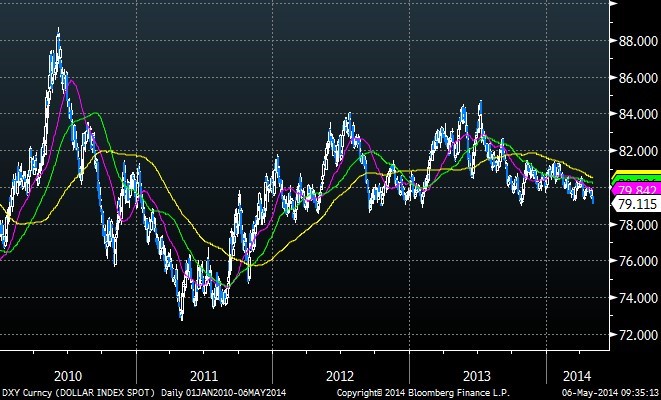
Is the US dollar headed for a fall despite positive economic data recently?

Stronger than expected non-farm payrolls and a surging composite PMI data were not enough to send real interest rates higher. Treasury yields have fallen due to Ukrainian tensions and weaker than expected PMI data from China. The net effect of these developments has been a weaker US dollar, which looks to be in danger of falling to its lowest levels in two years on a trade-weighted basis.

1Q-2014 US GDP Growth Estimate

By Uncategorized

1Q-2014 US GDP Growth Estimate

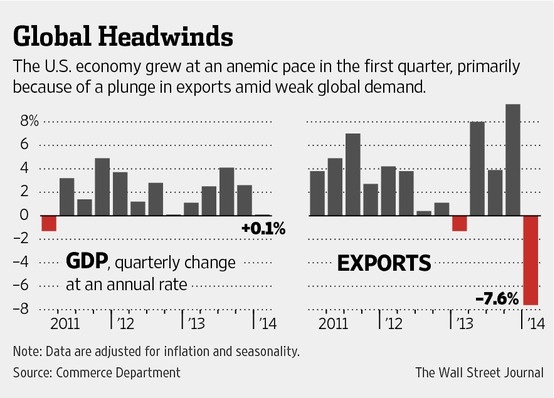
The Commerce Department reported that the gross domestic product (GDP) only advanced at a 0.1 percent annualized rate in the first three months of the year. According to the Wall Street Journal, economists on average were anticipating at least 1.1 percent growth. While this proved to be one of the weakest quarters for economic growth in the last five years, there were some bright spots in the report, such as total consumer spending rising by 3 percent. Most of the drag was a result of a 2.1 percent decline from business investment spending, which is being attributed to poor weather conditions. While weak business spending could prove to be temporary, the most concerning part of the report was that U.S. exports declined by 7.6 percent, the largest decline since the recession. This portion of the report should be met with some concern considering weakness in other economies around the world could end up being a rather large deterrent to U.S. economic growth, just as domestic consumption is starting to show some durability.

(Source: Wall Street Journal)


EWM Monthly Market Commentary: April 2014

By Uncategorized

Domestic equity markets were a study in contrasts in April, with significant divergence among various segments of the market. The key story of the month was the continued rotation in leadership within market capitalizations as well as growth-value dimensions. In addition, Internet-related growth stocks suffered declines as investors assessed whether those companies would live up to their high current valuations. Geopolitical tensions remained at the forefront of investors’ minds, with Russia continuing its saber-rattling in regards to Ukraine. Economic data began to thaw with the weather, posting slightly better results than during the first three months of the year. Employment gains in April were 288,000, the fastest growth in almost two years, and far exceeding analyst expectations. In addition, the unemployment rate dropped to 6.3% from 6.7%.

With this as a backdrop, stocks posted mixed results. The S&P 500 rose +0.7% for the month, and the Dow Jones Industrials gained +0.9%. However, the tech-heavy Nasdaq Composite Index again lost ground, declining -2.0%. The divergence between the Russell 1000 Index of large cap stocks and Russell 2000 Index of small cap stocks increased during the month, with returns of +0.5% and -3.9%, respectively. Value stocks extended their outperformance relative to  growth stocks. In terms of sector performance, energy was the strongest performer on a relative basis, gaining +5.2%, while financials were the poorest performers, posting a decline of -1.5%.

International equity markets also posted mixed results in April. The MSCI World ex-U.S. Index gained +1.4% for the month. Emerging markets also held their own again last month, advancing lightly, yet underperforming developed markets. Analysts remain concerned about the growth prospects in  emerging economies, which may remain subdued as the Federal Reserve continues to taper its quantitative easing program. The MSCI Emerging Markets Index gained +0.4% for the month. The MSCI EAFE Index, which measures developed markets performance, generated slightly better performance, returning +1.5% for the month, as the Russia-Ukraine tensions remained elevated but not yet escalating. Regionally, Latin America and Europe were the best performers on a relative basis, with the MSCI EM Latin  America Index and the MSCI Europe Index gaining +2.8% and +2.6%, respectively. Eastern Europe and Japan were among the poorest performers, with results of -4.5% and -2.6%, respectively.

Fixed-income markets were almost all high in April, with economic data remaining somewhat soft coming out of the severe winter. The Fed continued its pace of tapering of its asset purchase program during the month, reducing purchases by an additional $10 billion. In this environment, the benchmark 10-year U.S. Treasury yield ended the month at 2.65%, down slightly from the 2.72% the level of March 31st. Broad-based fixed-income indices posted returns in April, with the Barclays U.S. Aggregate Bond Index advancing +0.8% for the month. Global fixed-income markets were also higher, with the Barclays Global Aggregate ex-U.S. Index returning +1.3% for the month. Intermediate-term corporate bonds were also strong, as the Barclays U.S. Corporate 5-10 Year Index generated a gain of +1.2%. The Barclays U.S. Corporate High Yield Index posted a gain of +0.6% for the month. Municipals continued their recent robust performance, advancing +1.2%.

US Core Personal Consumption Expenditure Index Year over Year

By Inflation Watch

US PCE Core Year over Year


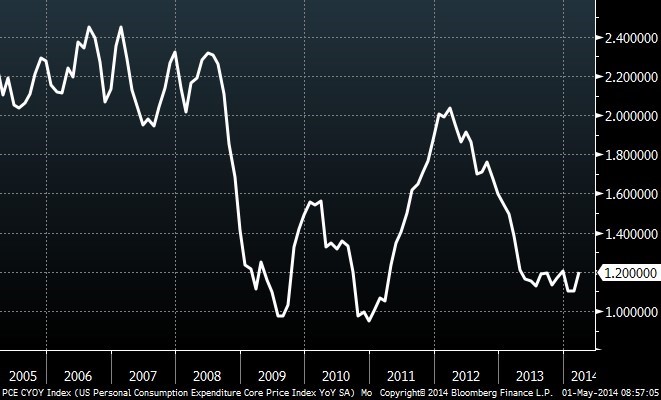
Yesterday we noted stagnant price growth in Europe, but the environment in the US is hardly inflationary. The Federal Reserve’s favorite inflation metric, the core Personal Consumption Expenditure index (PCE), grew 1.2% Y/Y in March, in-line with expectations and slightly higher than February. Janet Yellen and company really need this index to turn higher as they continue to withdraw stimulus from the economy. The FOMC sounded optimistic about growth after yesterday’s meeting, where it cut monthly asset purchases to $45bn. If PCE indicators were to fall from current levels, it would be interesting to see whether the Fed would reverse course by increasing asset purchases or opt for a new strategy.

(Source: GBI)

What are Option Greeks?

By General

Greeks, including Delta, Gamma, Theta, Vega and Rho, measure the different factors that affect the price of an option contract. They are calculated using a theoretical options pricing model (see  How much is an option worth?).

Since there are a variety of market factors that can affect the price of an option in some way, assuming all other factors remain unchanged, we can use these pricing models to calculate the Greeks and determine the impact of each factor when its value changes. For example, if we know that an option typically moves less than the underlying stock, we can use Delta to determine how much it is expected to move when the stock moves $1. If we know that an option loses value over time, we can use Theta to approximate how much value it loses each day.

Following are Greek definitions:

Delta: The hedge ratio

Delta measures how much an option’s price is expected to change per $1 change in the price of the underlying security or index. For example, a Delta of 0.40 means that the option’s price will theoretically move $0.40 for every $1 move in the price of the underlying stock or index.

Call options

  • Have a positive Delta that can range from zero to 1.00.
  • At-the-money options usually have a Delta near .50.
  • The Delta will increase (and approach 1.00) as the option gets deeper in the money.
  • The Delta of in-the-money call options will get closer to 1.00 as expiration approaches.
  • The Delta of out-of-the-money call options will get closer to zero as expiration approaches.

Put options

  • Have a negative Delta that can range from zero to -1.00.
  • At-the-money options usually have a Delta near -.50.
  • The Delta will decrease (and approach -1.00) as the option gets deeper in the money.
  • The Delta of in-the-money put options will get closer to -1.00 as expiration approaches.
  • The Delta of out-of-the-money put options will get closer to zero as expiration approaches.

You also might think of Delta, as the percent chance (or probability) that a given option will expire in the money.

  • For example, a Delta of 0.40 means the option has about a 40% chance of being in the money at expiration. This doesn’t mean your trade will be profitable. That of course, depends on the price at which you bought or sold the option.

You also might think of Delta, as the number of shares of the underlying stock, the option behaves like.

  • A Delta of 0.40 also means that given a $1 move in the underlying stock, the option will likely gain or lose about the same amount of money as 40 shares of the stock.

Gamma: the rate of change of Delta

Gamma measures the rate of change in an option’s Delta per $1 change in the price of the underlying stock. Since a Delta is only good for a given moment in time, Gamma tells you how much the option’s Delta should change as the price of the underlying stock or index increases or decreases. If you remember high school physics class, you can think of Delta as speed and Gamma as acceleration.

The relationship between Delta and Gamma:

  • Delta is only accurate at a certain price and time. In the Delta example above, once the stock has moved $1 and the option has subsequently moved $.40, the Delta is no longer 0.40.
  • As we stated, this $1 move would cause a call option to be deeper in the money, and therefore the Delta will move closer to 1.00. Let’s assume the Delta is now 0.55.
  • This change in Delta from 0.40 to 0.55 is 0.15—this is the option’s Gamma.
  • Because Delta can’t exceed 1.00, Gamma decreases as an option gets further in the money and Delta approaches 1.00.

Theta: time decay

Theta measures the change in the price of an option for a one-day decrease in its time to expiration.  Simply put, Theta tells you how much the price of an option should decrease as the option nears expiration.

  • Since options lose value as expiration approaches, Theta estimates how much value the option will lose, each day, if all other factors remain the same.
  • Because time-value erosion is not linear, Theta of at-the-money (ATM), just slightly out-of-the-money and in-the-money (ITM) options generally increases as expiration approaches, while Theta of far out-of-the-money (OOTM) options generally decreases as expiration approaches.

Time-value erosion

 Time value erosion

Source: Schwab Center for Financial Research.

Vega: sensitivity to volatility

Vega measures the rate of change in an option’s price per 1% change in the  implied volatility of the underlying stock. While Vega is not a real Greek letter, it is intended to tell you how much an option’s price should move when the volatility of the underlying security or index increases or decreases.

More about Vega:

  • Vega measures how the implied volatility of a stock affects the price of the options on that stock.
  • Volatility is one of the most important factors affecting the value of options.
  • Neglecting Vega can cause you to “overpay” when buying options.  All other factors being equal, when determining strategy, consider buying options when Vega is below “normal” levels and selling options when Vega is above “normal” levels. One way to determine this is to compare the historical volatility to the implied volatility. Chart studies for both of these values exist within StreetSmart Edge®.
  • A drop in Vega will typically cause both calls and puts to lose value.
  • An increase in Vega will typically cause both calls and puts to gain value.

Rho: sensitivity to interest rates

Rho measures the expected change in an option’s price per 1% change in interest rates. It tells you how much the price of an option should rise or fall if the “risk-free” (U.S. Treasury-bill)* interest rate increases or decreases.

More about Rho:

  • As interest rates increase, the value of call options will generally increase.
  • As interest rates increase, the value of put options will usually decrease.
  • For these reasons, call options have positive Rho and put options have negative Rho.
  • Rho is generally not a huge factor in the price of an option, but should be considered if prevailing interest rates are expected to change, such as just before a Federal Open Market Committee (FOMC) meeting.
  • Long-Term Equity AnticiPation Securities® (LEAPS®) options are far more sensitive to changes in interest rates than are shorter-term options.

You can see the effects of Rho by considering a hypothetical stock that’s trading exactly at its strike price.

  • If the stock is trading at $25, the 25 calls and the 25 puts would both be exactly at the money.
  • You might see the calls trading at a price of $0.60, while the puts may trade at a price of $0.50.
  • When interest rates are low, the difference will be relatively small.
  • As interest rates increase, this difference between puts and calls whose strikes are equidistant from the underlying stock will get wider.

What can option Greeks do for you?

Armed with Greeks, an options trader can make more informed decisions about which options to trade, and when to trade them. Consider some of the things Greeks may help you do:

  • Gauge the likelihood that an option you’re considering will expire in the money (Delta).
  • Estimate how much the Delta will change when the stock price changes (Gamma).
  • Get a feel for how much value your option might lose each day as it approaches expiration (Theta).
  • Understand how sensitive an option might be to large price swings in the underlying stock (Vega).
  • Simulate the effect of interest rate changes on an option (Rho).

Implied volatility: like a Greek

Though not actually a Greek, implied volatility is closely related. The implied volatility of an option is the theoretical volatility based on the option’s quoted price. The implied volatility of a stock is an estimate of how its price may change going forward. In other words, implied volatility is the estimated volatility of a stock that is implied by the prices of the options on that stock. Key points to remember:

  • Implied volatility is derived using a theoretical pricing model and solving for volatility.
  • Since volatility is the only component of the pricing model that is estimated (based on historical volatility), it’s possible to calculate the current volatility estimate the options market maker is using.
  • Higher-than-normal implied volatilities are usually more favorable for options sellers, while lower-than-normal implied volatilities are more favorable for option buyers because volatility often reverts back to its mean over time.
  • To an options trader, solving for implied volatility is generally more useful than calculating the theoretical price, since it’s difficult for most traders to estimate future volatility.
  • Implied volatility is usually not consistent for all options of a particular security or index and will generally be lowest for at-the-money and near-the-money options.

Since it’s difficult on your own to estimate how volatile a stock really is, you can watch the implied volatility to know what volatility assumption the market makers are using in determining their quoted bid and ask prices.

How much is an option worth?

It seems like a fairly simple question, but the answer is complex. There’s a lot of number crunching that goes into determining an option’s price. Most options market makers use some variation of what’s known as a theoretical options pricing model.

By far, the best-known pricing model is the Black-Scholes model. After more than three years of research, university scholars Fisher Black and Myron Scholes published their model back in 1973, only a month after the Chicago Board Options Exchange (CBOE) began trading standardized options. While options traders initially scoffed at their ideas, this breakthrough was so ahead of its time that it took a quarter century to be fully appreciated. Though Fisher Black died in 1975, Myron Scholes along with Robert Merton, a colleague of theirs who helped improve the formula, were awarded the Nobel Prize in Economics for their model in 1997.

While the original model was groundbreaking, it had a few limitations because it was designed for European style options and it did not take into consideration, the dividend yield of the underlying stock. There are now many variations, which have improved upon the original model, including:

  • Cox-Ross-Rubenstein binomial (1979): for American style options including dividend yield. This is probably the most widely used model today because it’s very accurate with American-style equity options.
  • Barone-Adesi-Whaley: for American style options including dividend yield.
  • Black-Scholes-Merton (our default model): for American style options including dividend yield.

Each model estimates what an option is worth by considering the following six factors:

  • Current underlying stock price (higher value increases calls and decreases puts).
  • Strike price of the option (higher value decreases calls and increases puts).
  • Stock price volatility (estimated by the annual standard deviation, higher value increases calls and puts).
  • Risk-free interest rate (higher value increases calls and decreases puts).
  • Time to expiration (as a percent of a year, higher value increases calls and puts).
  • Underlying stock-dividend yield (higher value decreases calls and increases puts).

(Source: Original article from Schwab was repurposed for this Blog post)

Yellen Concerned Fed Model Fails to Predict Price Moves

By Inflation Watch

Federal Reserve Chair Janet Yellen is concerned that the standard models central banks use to forecast inflation may be broken.

Behind her disquiet: the failure of the models to foresee the path of prices in the U.S. during the last recession and its aftermath and in Japan during its deflationary period from 1998 to 2012. U.S. inflation has been higher than the simulations suggested, while Japanese price declines proved more persistent.

Yellen alluded to her concerns in a speech last week, saying the Fed has to “watch carefully” to see if inflation picks up as the central bank projects — and hopes — during the next few years.

Standard computer models rest on two main pillars in trying to forecast longer-run price pressures: the amount of slack in the economy, usually measured by unemployment, and inflation expectations.

The higher the joblessness rate is above its so-called natural rate, the harder it is for employees to win pay increases and for inflation to accelerate. Yellen pegs that natural rate — at which price increases neither speed up nor slow down — at 5.2 percent to 5.6 percent. Unemployment in March was 6.7 percent.

Most Fed policy makers see inflation climbing to 1.5 percent to 2 percent by the end of next year and 1.7 percent to 2 percent at the end of 2016, according to projections released on March 19.

(Source: Bloomberg)