All Posts By

EWM Team

What about the Shiller PE Ratio?

By Uncategorized

The strong performance of stocks in 2013 has many commentators describing the current market as being in a bubble. And often they cite the Shiller P/E [price-to-earnings] ratio, a measure developed by Yale economist and Nobel Prize winner Robert Shiller.

As of March 19, 2014, the Shiller P/E stood at 25.4, much higher than the historical average of 16.5. If a value of 16.5 indicates that the market is fairly valued, as some commentators believe, then the current market is more than 50% overvalued. (See Chart below)

Shiller PE Ratio on S&P 500


The Shiller P/E is a twist on the traditional P/E. It takes the previous 10 years’ earnings on the S&P 500® Index, adjusts them to current dollars, averages them, and then divides this result into the S&P 500’s current market capitalization. By relying on 10 years of earnings, the Shiller P/E mitigates the earnings volatility that can distort the traditional market P/E.

One problem with this measure, however, is that it may be used in a way that is too restrictive. If a reading of over 16.5 means that the market is “overvalued,” then stocks have been “overvalued” for most of the past two decades. Since January 1991, the Shiller P/E has been above average for 268 of the past 278 months.

Yet, during that time, the S&P 500 has more than quintupled, rising from 326.4 (on January 2, 1991) to more than 1,860 (as of March 19, 2014). Including dividends, this amounts to a compound annual return of 10.1%. Clearly, investors using the Shiller P/E in order to avoid an “overvalued” market would have missed out on significant gains.

The Shiller P/E is not, however, without its critics. Wharton professor Jeremy Siegel, for example, has pointed out that the metric may be biased upward because of accounting rule changes made in the late 1990s. These changes require that assets be written down when they lose value and then charged against income. Increases in asset prices, however, are not recorded unless the assets are sold.

These changes create a downward bias in reported GAAP earnings, says Siegel, resulting in an upward bias in the Shiller P/E. Siegel also believes these accounting changes make comparisons of today’s earnings with those reported before the changes invalid. He recommends that for an apples-to-apples comparison with today’s market, only the last 15 years of Shiller P/Es be used. The average over this period (December 1998 to December 2013) is 26.5, further suggesting that current valuations may not be as unreasonable as many suggest.

Those arguing for a market bubble also cite corporate profit margins, which are near record highs and which some believe are likely to return to more normal levels soon. But many factors are behind the higher profitability, including low interest rates and favorable tax rates in international markets, neither of which is likely to change soon.

Operating leverage is also responsible for the improved profits, according to Milton Ezrati, Lord Abbett Partner, Senior Economist and Market Strategist. “The capital intensity of U.S. business enhances productivity, but it also raises fixed costs relative to total costs, and these fixed costs don’t go away during an economic downturn the way employee costs do,” said Ezrati. “Fixed costs must be covered even when revenues decline, so when sales fall, earnings may drop precipitously,” he added. “But when revenues rise, much of the increase goes right to the bottom line, as the fixed costs are covered.”

This positive effect may persist for a while, according to Ezrati. The economy is still using only 78.5% of its existing capacity, according to the Federal Reserve, suggesting that firms still have more equipment to bring online, which would allow even more revenues to flow to the bottom line.

(Source: Lord Abbett)


Citi Economic Surprise Index

By Uncategorized

Citi Economic Surprise Index

The Citi Economic Surprise Index tracks actual economic data relative to consensus expectations. When the index is above zero, economic data releases are coming in better than expected, and conversely, readings below zero signal economic data releases are below expectations. Since mid-January, the index has been falling and is now in negative territory, indicating a slowdown in economic activity relative to expectations. Some, but not all, of this weakness can be attributed to the harsh winter weather. However, we could be near a low in this measure as economists begin to incorporate new information into their forecasts.

(Source: Citigroup)

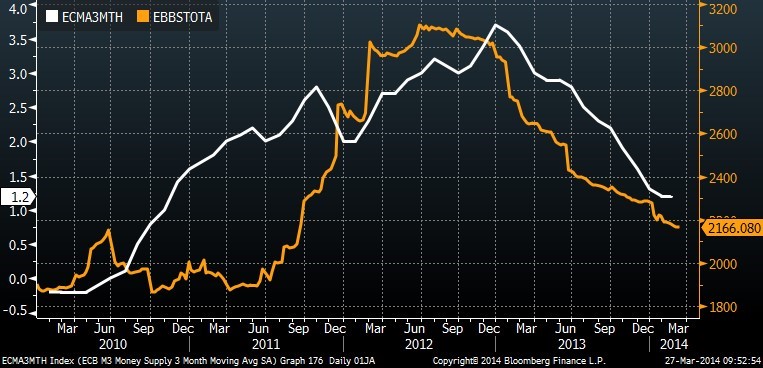
ECB Balance Sheet (orange) – EU M3 Money Supply (white)

By Uncategorized

ECB Balance Sheet & EU M3 Money Supply


This graph shows why Deflation is a bigger worry in Europe right now.

While it’s difficult to distinguish cause from effect between these two monetary indicators they both point towards deflation in Europe. The latest reading from February showed that the 3-month average of M3 money supply growth in the Eurozone remained 1.2% Y/Y. Ostensibly the Germans oppose balance sheet expansion because it is inflationary in nature. Conversely, balance sheet contraction is deflationary in nature; it’s just a matter of picking your poison.

(Source: Bloomberg & GBI)

Sequoia Capital on the Forbes Midas List

By General

Some number highlights copied from the Forbes article below:

The past year Sequoia’s scrappy methods have produced the firm’s biggest gains ever. A record nine Sequoia partners appear on the FORBES Midas List of the most successful venture capitalists, thanks to the firm’s lucrative investment in companies such as Airbnb, Dropbox, FireEye, Palo Alto Networks, Stripe, Square and WhatsApp. At the No. 1 spot is Sequoia partner Jim Goetz, who backed WhatsApp in 2011, well before Facebook agreed to buy the mobile-messaging company for $19 billion. Leone ranks No. 6, followed by colleagues Michael Moritz, Alfred Lin, Roelof Botha, Neil Shen, Michael Goguen, Bryan Schreier and Kui Zhou.

Consider Sequoia Venture XI Fund, which in 2003 raised $387 million from about 40 limited partners, chiefly universities and foundations. Eleven years later Venture XI has booked $3.6 billion in gains, or 41% a year, net of fees. Sequoia’s partners stand to collect 30%, or $1.1 billion, while limited partners get 70%, or another $2.5 billion. Look for even more outsize returns from Venture XIII (2010), which is up 88% a year so far, and Venture XIV (2012). The latter two will split the $3 billion or so Sequoia takes home from the WhatsApp deal. Add it up and Sequoia is turning its own partners into billionaires while keeping outside investors purring.

http://www.forbes.com/sites/georgeanders/2014/03/26/inside-sequoia-capital-silicon-valleys-innovation-factory/

(Source: Forbes)


Janet Yellen’s First Fed Meeting: Forward Guidance

By Market Outlook

HIGHLIGHTS:

  • The Fed announced an additional $10 billion per month in tapering, split evenly between Treasuries and MBS.
  • The Fed dropped its reference to 6.5% as a threshold for when they would hike short-term interest rates and indicated that they would follow a “broad array” of indicators, including “financial developments”.
  • The majority of members of the FOMC still see the first rate hike in 2015, but the pace of rate hikes is projected to be slightly quicker than previously estimated, even though the economic projections were adjusted downward.
  • There was one dissenting vote by Kocherlakota who favored sticking with the unemployment and inflation guidelines.

This was the first meeting for Janet Yellen to preside as Chairwoman, but it is also one with some unfilled seats. While there is plenty of uncertainty with many of the voting members in 2014, we think that the overall composition of the FOMC is likely to be more hawkish this year. While we don’t expect a significant change to current policies in the near term, we think that the changes at the Fed could mean we’ll be hearing differing views in the year ahead.

The Fed’s slower pace of bond buying means that its influence on Treasury yields will continue to decline, while the pace of economic growth and inflation prospects are likely to play a larger role in setting policy. We don’t see the shift from the numerical threshold of 6.5% unemployment to more qualitative information is all that different from the Fed’s previous approach. It allows the Fed more flexibility on policy, but may make it more difficult for investors to assess the Fed’s next steps. Treasury bond yields initially moved higher in reaction to the Fed’s statement, perhaps because of the indication that interest rates might move up more quickly once rate hikes begin. However, in her press conference, Yellen explained that the Fed remains committed to reducing unemployment and keeping inflation in check. All in all, our view is that the Fed is still committed to a “measured” approach to changing policy.

Apax Partners LLP stands to score a 10,000 percent gain on its 2005 investment in King Digital Entertainment Plc (KING)

By General

Buyout firm Apax Partners LLP stands to score a 10,000 percent gain on its 2005 investment in King Digital Entertainment Plc (KING) as the maker of smartphone game “Candy Crush Saga” prepares its initial public offering.

In one of its last venture capital deals before it abandoned that business, London-based Apax injected about $35 million into King, according to a person with knowledge of the deal, who asked not to be named because the terms are private. The games maker set terms last week for the IPO that would value it at as much as $7.6 billion. Apax’s stake could be worth $3.5 billion.

While Dublin-based King has developed more than 180 games in the past decade, “Candy Crush,” a puzzle game that features colored candies, fueled most of its growth. The potential windfall comes as venture capitalists are seeing their best returns since the late 1990s dot-com bubble. Twelve venture-backed companies went public in the U.S. last year with market capitalizations above $1 billion at the time of offering.

(Source: Bloomberg)

U.S. crude oil production in 2013 reaches highest level since 1989

By General

Total U.S. crude oil production averaged 7.5 million bbl/d in 2013, 967,000 barrels per day (bbl/d) higher than 2012 and the highest level of U.S. production since 1989. In December 2013, U.S. crude oil production reached 7.9 million barrels per day (bbl/d), according to EIA’s recently released December 2013 Petroleum Supply Monthly, an increase of 785,000 bbl/d (11%) compared with December 2012.

(Source: EIA)

What is HFT? Who is Vincent Viola and Virtu Financial?

By General

High-frequency trading (HFT) is a type of algorithmic trading, specifically the use of sophisticated technological tools and computer algorithms to rapidly trade securities. HFT uses proprietary trading strategies carried out by computers to move in and out of positions in seconds or fractions of a second. Firms focused on HFT rely on advanced computer systems, the processing speed of their trades and their access to the market.

As of 2009, studies suggested HFT firms accounted for 60-73% of all US equity trading volume, with that number falling to approximately 50% in 2012.

High-frequency traders, move in and out of short-term positions aiming to capture sometimes just a fraction of a cent in profit on every trade. HFT firms do not employ significant leverage, accumulate positions or hold their portfolios overnight; they typically compete against other HFTs, rather than long-term investors. As a result, HFT has a potential Sharpe ratio (a measure of risk and reward) thousands of times higher than traditional buy-and-hold strategies.

HFT may cause new types of serious risks to the financial system. Algorithmic and HFT were both found to have contributed to volatility in the May 6, 2010 Flash Crash, when high-frequency liquidity providers rapidly withdrew from the market. Several European countries have proposed curtailing or banning HFT due to concerns about volatility. Other complaints against HFT include the argument that some HFT firms scrape profits from investors when index funds rebalance their portfolios.

History

Profiting from speed advantages in the market is as old as trading itself. In the 17th century, the Rothschilds were able to arbitrage prices of the same security across country borders by using carrier pigeons to relay information before their competitors. HFT modernizes this concept using the latest communications technology.

High-frequency trading has taken place at least since 1999, after the U.S. Securities and Exchange Commission (SEC) authorized electronic exchanges in 1998. At the turn of the 21st century, HFT trades had an execution time of several seconds, whereas by 2010 this had decreased to milli- and even microseconds. Until recently, high-frequency trading was a little-known topic outside the financial sector, with an article published by the New York Times in July 2009 being one of the first to bring the subject to the public’s attention. On September 2, 2013, Italy became the world’s first country to introduce a tax specifically targeted at HFT, charging a levy of 0.002% on equity transactions lasting less than 0.5 seconds.

In the United States, high-frequency trading firms represent 2% of the approximately 20,000 firms operating today, but account for 73% of all equity orders volume.

As HFT strategies become more widely used, it can be more difficult to deploy them profitably. According to an estimate from Frederi Viens of Purdue University, profits from HFT in the U.S. has been declining from an estimated peak of $5bn in 2009, to about $1.25bn in 2012.
Vincent “Vinnie” Viola, the founder of Virtu Financial Inc, is High Frequency Trading’s (HFT) first billionaire. He has an impressive track record of just “one losing trading day” during a 1,238 trading-day period.

How does he do it? The same way other High-Frequency Traders do it: front running trades and scalping countless billions and billions of fractions-of-pennies in the process.

High-frequency trading could soon officially mint its first billionaire.

Vincent “Vinnie” Viola, the founder of Virtu Financial Inc., could have his stake valued at around $2 billion once the company sells shares to the public, according to two people familiar with the matter.

In a filing Monday, Virtu said it hoped to raise $100 million in an initial public offering, though that figure is just a placeholder that could change based on investor demand. The company will likely seek to raise between $200 million and $250 million, according to the people. At the high end of that range, Virtu would be valued at about $3 billion.

Mr. Viola owns almost 70% of the company. Virtu is hoping that its stellar record – having just “one losing trading day” during a 1,238 trading-day period concluding at the end of December – will grab the interest of investors despite growing scrutiny of the high-frequency trading industry.

Virtu said in its prospectus that the U.S. Commodity Futures Trading Commission was “looking into our trading during the period from July 2011 to November 2013.”

The CFTC is examining Virtu’s “participation in certain incentive programs offered by exchanges or venues during that time period.” Virtu said it didn’t believe it violated any statute or regulatory provision.

The Securities and Exchange Commission has also said it is looking into the impact of high-frequency traders on market stability and fairness.

In addition, a French regulator, Autorité des Marchés Financiers, is examining the 2009 trading activities of a company that eventually became part of Virtu, the prospectus said.

Virtu declined to comment on the regulatory inquiries.

Mr. Viola gained attention last year after paying $240 million for control the Florida Panthers of the National Hockey League. He put his Manhattan mansion on the market for $114 million in December.

(Sources: Various, Wall Street Journal, New York Times)