All Posts By

EWM Team

Bull Market Top Checklist

By Uncategorized

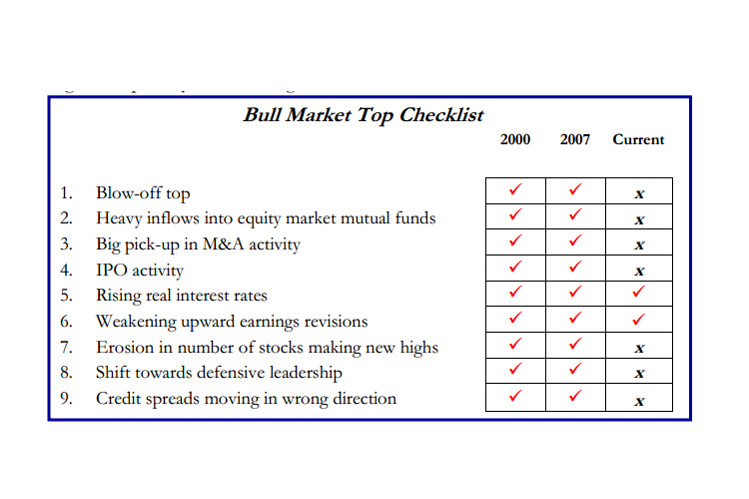
Strategas Bull Market Top Checklist


(Source: Strategas)

Investors who are worried about the market’s parabolic rise in the past five years and whether we are at or near a top, can use the above table to judget where we are in the cycle and whether the tide is about to turn the other way.

Annual Change in U.S. Labor Productivity

By Uncategorized

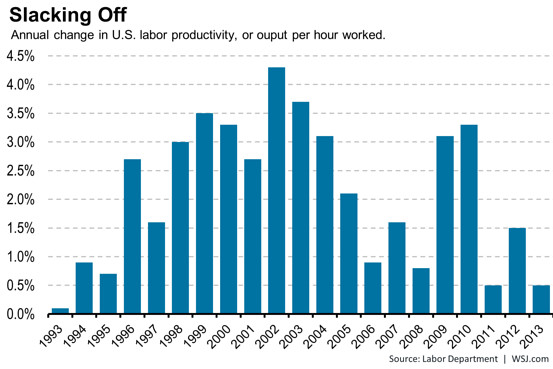
Annual Change in U.S. Labor Productivity


Businesses struggled to squeeze much more out of their workers last year.

A downward revision to fourth-quarter productivity lowered the gain for all of 2013 to just 0.5%, the Labor Department said Thursday. The small increase ties with 2011 for the weakest annual improvement since 1993.

Labor productivity, or output per hour, strengthened early in the economic recovery as businesses grew more efficient. The measure increased 3.1% in 2009 and 3.3% in 2010, to mark the best annual improvement since 2003. But gains have slowed considerably since, measuring 0.5% in 2011 and 1.5% in 2012.

The recent weakness was most pronounced in nondurable manufacturing, a sector that includes the processing of food, chemicals and petroleum, as well as textile and paper production. Sector productivity slipped 0.1% last year because output improvements were more than offset by increased hours worked.

The easing of productivity is a bit of a double-edged sword. The weak gains hold back the economy’s potential to grow. But it also could signal that businesses are finding it more difficult to meet demand with their existing workforce and equipment.

If companies can’t squeeze more out of current workers, they might need to ramp up hiring and capital investment.

(Source: Wall Street Journal)

U.S. Unemployment Rate by Education

By Uncategorized

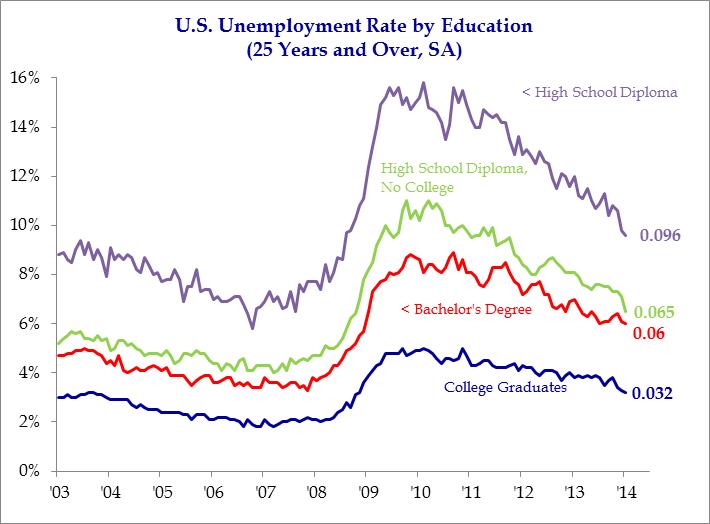
US Unemployment Rate by Education


The U.S. unemployment rate fell to 6.6% in January, the lowest level since October 2008. The unemployment rate has been steadily falling since it peaked at 10% on October 2009. The rate of unemployment has been significantly different depending on the education level of the labor force participant. College graduates currently have an unemployment rate of 3.2%, while those with less than a high school diploma still struggle to find work.

(Sources: Strategas Research Partners, LLC, BLS)

15 Great Quotes About Behavioral Finance

myRA: What you need to know by Rob Riedl

By Uncategorized

1. What is a myRA?

The myRA (rhymes with IRA) is a new workplace retirement savings account discussed by President Obama in the State of the Union address and subsequently authorized by executive order. The administration hopes that employers who currently don’t offer a workplace retirement plan will make myRAs available to their employees. Only limited details are currently available.

The myRA is a regular Roth IRA with some special features. Your contributions are made on an after-tax basis through payroll deduction. Your contributions are tax-free when withdrawn, and earnings are also tax-free if certain requirements are met. Contributions are invested in newly created government bonds that earn the same variable interest rate that’s available through the government’s Thrift Savings Plan Government Securities Investment Fund (G Fund). For reference, the G Fund earned 2.45% in 2011 and 1.47% in 2012. Your account principal is fully protected — the value of your account can never go down, and the bonds are backed by the full faith and credit of the U.S. government.

2. Is it available now?

No. It is anticipated that the program will start in 2015.

3. Do employers have to offer the myRA?

No. The plan is voluntary. Employers need to sign up by the end of 2014 in order to participate in the pilot program.

4. Do employees have to contribute?

No. Unlike the Auto-IRA that has also been proposed by President Obama, but not yet enacted, employee contributions are totally voluntary.

5. Who can contribute?

According to the White House, myRA accounts are available to “households earning up to $191,000.”

6. Will employers contribute to the myRA?

No.

7. How much can I contribute?

You can open an account with as little as $25, and additional contributions can be as little as $5. You can keep your account if you change jobs. Again, details are limited, but presumably you can contribute up to the annual IRA limit (the limit for 2014 is $5,500), and that would include all of your myRA, traditional IRA and regular Roth IRA contributions. However, once your account reaches $15,000 (or you have had the account for 30 years, whichever comes first) you’re required to transfer the account into a private-sector Roth IRA.

8. When can I access my funds?

This is not entirely clear. According to the Obama administration’s instructions to the Treasury, you can access your funds if you have an emergency. It is not currently clear, however, if the regular Roth IRA distribution rules — which don’t limit withdrawals to emergencies — also apply. (The regular rules allow you to access your funds at any time. Your own contributions are tax-free when withdrawn; earnings are tax-free if you are at least 59½, or disabled, or a first-time homebuyer, and you also satisfy a five-year holding period.) You can transfer your myRA account balance to a private-sector Roth IRA at any time.

9. Why should I invest in a myRA instead of a regular Roth IRA?

The distinguishing features of a myRA are the ability to contribute through payroll deduction, access to the new retirement bond, safety of principal, and the ability to make very small contributions. There will also be no fees to establish or maintain the myRA. However, the myRA, with its single investment option and $15,000 cap, lacks the flexibility of a regular Roth IRA. If you can afford the minimum investment to establish an account, a regular Roth IRA may be the better option.

http://www.nerdwallet.com/blog/finance/2014/myra-what-need-to-know/

 

At Year End, 55 Tax Provisions Expired Creating Taxpayer Uncertainty

By General

To budget accordingly, you must know which ones have far-reaching ramifications.


The expiration of the Federal tax provisions will almost certainly have an adverse impact on a wide swath of taxpayers; increasing the effective tax rate of both large and small businesses, with additional collateral damage to individuals and charitable organizations. Notable expired provisions include higher Section 179 limits, bonus depreciation, energy tax incentives, the R&D credit, and many others.

At the time of this writing, the prospect for retroactive extension of these provisions is unclear at best. Sen. Harry Reid introduced an extender bill (S. 1859) in December that failed to pass by unanimous consent. The Senate Finance Committee is working on another extender bill, but members of both parties have expressed their preference for comprehensive tax reform in favor of tax extender legislation. Whether or not such legislation will be enacted prior to the upcoming mid-term election is anyone’s guess, but by historical standards prospects for near-term, comprehensive tax reform are dim.

Access this comprehensive list now to find out which Expiring Federal Tax Provisions (2013-2023) impact you »

Cap Rates decline in 2013

By General

Capitalization rates, used by real-estate investors to measure the annual return of income-producing properties, declined for many property types in 2013, according to data from Real Capital Analytics in New York. Meanwhile, the spread between cap rates and yields on 10-year Treasury notes narrowed. The average cap rate for all property types was 6.74% last year, down from 6.76% in 2012. Cap rates fell fastest for office buildings, which had an average cap rate of 6.93% in 2013 compared with 7.15% in 2012.

(Source: Wall Street Journal)

Average S&P 500 TTM PE vs. CPI

By Uncategorized

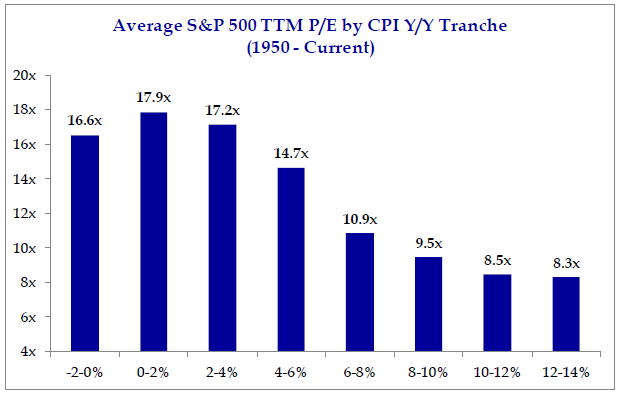
Avg S&P TTM PE by CPI (1950 to Current)


Equity valuations are still reasonable, especially when considering the inflation environment. Historically, inflation between 0%-2% (CPI is currently running at 1.2% year over year) has been a sweet spot for valuations. Even inflation readings up to 4% have been supportive for valuations. Concerns for multiples would arise if we see either deflation or inflation greater than 4%.

(Sources: Strategas Research Partners, LLC &  Brinker Capital, Inc.)