Growth of solo businesses

By General

The Number of US Businesses without paid employees, in millions


Is the growth in the number of solo businesses a good sign for the economy?

The number of U.S. businesses without paid employees—mostly self-employed individuals with unincorporated businesses—rose 1.1% to 22.74 million in 2012, the latest data available, according to a new report by Census this week. “Non-employer” businesses have increased nearly 7% since dipping to 21.35 million in 2008, the first full year of the 2007-2009 recession.

The new Census data jibe with reports from the Labor Department that suggest self-employment took a hit during the recession but has since come back slightly.

Overall, the readings could be a sign that some Americans are feeling more confident about their ability to launch businesses as the economy gradually recovers from the recession. But it could also point to the persistent difficulty many face in landing full-time jobs.

(Source: Wall Street Journal)

Pump Prices Help to Drive Inflation Outlook

By Inflation Watch

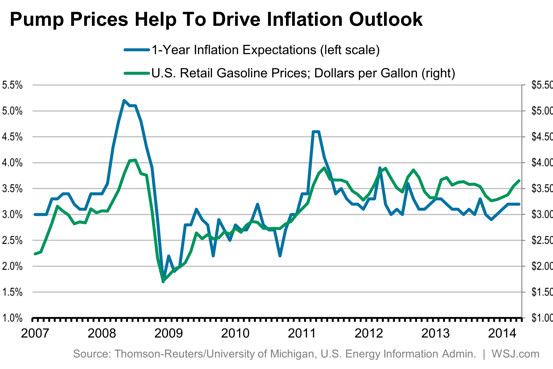
Pump Prices Help To Drive Inflation Outlook


While we watch many indicators that might point to a future rise in inflation, the above chart depicts how consumers correlate near term inflation expectations with prices paid at the pump.

According to Friday’s consumer sentiment survey put out by Thomson-Reuters and the University of Michigan, consumers think inflation will be 3.2% a year from now, little changed from expectation readings so far this year. (Consumers almost always think inflation is running higher than the government’s official measures. The consumer price index, for instance, shows prices are up just 1.5% in the past year.)

Changes in gasoline prices tend to color how consumers view inflation. That’s not a surprise since gas prices are very visible and drivers tend to fill up frequently. Prices at the pump have been rising lately. Add in the price jump for some grocery items—most notably beef and pork—and it would not be surprising if inflation expectations edge up in coming months.

(Source: Wall Street Journal)


U.S. Equity Markets: Bull or Bear?

By General

We believe that it is hard to determine precisely whether you are at the end of a Bull run or at the beginning of a Bear cycle. However, one can look at a panoply of macro factors that might help in making a decision one way or the other. It is also possible that the two scenarious balance out and put you in a Neutral Zone. 

Factors that favor a continuing of the current Bull Market:

  • Continuing of current accomodative global monetary policy
  • U.S labor market continues to improve
  • U.S. auto sector continues to grow
  • U.S. housing affordability still attractive in most markets
  • Muted inflation
  • U.S. Current Account and Federal Budget deficits continue to shrink
  • Renaissance in U.S. energy production and manufacturing
  • U.S. corporations sitting on over $2 Trillion in cash
  • M&A and IPO activity picking up
  • Equity market valuations are reasonable particularly on a relative basis to bonds
  • Europe starting to grow its economy
  • China growth stabilizing alongwith other emerging markets like India and Brazil

Factors that Bears are making in support of a coming Bear Market:

  • Slow job improvement compared to past economic recoveries
  • Political and regulatory uncertainty continues hindering global capital investment and employment growth
  • End of QE in the U.S. prompting discussion of how equities might crash in a rapidly rising interest rate environment
  • High corporate profit margins might not be sustainable
  • Momentum investors have driven the valuations for many internet oriented and biotech stocks to very steep levels that might not be sustainable
  • U.S. IPOs might be showing signs of excessive speculation
  • U.S. equity markets have not had a 10% plus correction in over 30 months vs. a historical average of 18 months
  • 2nd quarters are usually the worst on both a price change and frequency of decline basis since WWII for the S&P 500

We are in a neutral zone with a bias towards Equities and Risk Managed asset classes on a relative and absolute return basis.

$2.1 Trillion in Untaxed Profits held Abroad by U.S. Corporations

By General

More than $2 trillion in foreign profits were held by U.S. corporations abroad in 2013, says Reuters.

U.S. corporations do not pay income tax on their overseas profits (something known as income tax deferral) unless they bring those profits back into the United States.

  • Between 2008 and 2013, the amount of profits held overseas by American corporations almost doubled.
  • General Electric alone had $110 billion overseas, followed by Microsoft (at $76.4 billion), Pfizer (at $69 billion) and Merck (at $57.1 billion).

This corporate tax issue has been at the center of congressional debate on tax reform. Some lawmakers have advocated getting rid of offshore deferral, and others have pushed for a “tax holiday” that would allow these corporations to bring foreign profits back into the United States at a low tax rate. Democratic Senator Max Baucus, former finance committee chairman, had made a number of tax reform proposals before leaving to become ambassador to China. Senator Ron Wyden has taken over Baucus’ post.

Analysts do not anticipate any real reform action until after the mid-term elections in November, but Americans can expect to see a push for a tax code overhaul in 2015.

Source: Kevin Drawbaugh and Patrick Temple-West, “Untaxed U.S. Corporate Profits Held Overseas Top $2.1 Trillion: Study,” Reuters, April 8, 2014.

Are the U.S. Equity Markets Over Valued?

By General

Every time the equity markets hit a new high, doubts begin to arise if the markets are getting too toppy/frothy. It is usually a good time to take a step back and put things in perspective. A good comparison is usually done by going back in time to when the markets peaked in March 2000. In that light, David Kostin, chief U.S. equity strategist at Goldman Sachs, looked at some data going back to March 2000 when the technology bubble peaked and subsequenty burst. I was really close to this time period, having moved to Silicon Valley to join a team doing late stage, pre-IPO, tech venture investing.

“Veteran investors will recall the S&P  500 and the tech-heavy Nasdaq peaked in March 2000.  The indices eventually fell by 50% and 75%, respectively. It took the S&P 500 seven years to recover and establish a new high, but the  Nasdaq still remains 25% below its all-time peak reached 14 years ago.”

However, according to Kostin, there are six ways in which the two episodes differ:

Recent returns are less dramatic. Although the trailing 12-month returns are similar (22% today versus 18% in 2000), the trailing 3-year and 5-year returns are much lower (51% vs. 107% and 161% vs. 227%, respectively).

Valuation is not nearly as stretched. S&P 500 currently trades at a forward P/E of 16x compared with 25x at the peak in 2000. The price/book ratio is 2.7x versus 6.Xx. The EV/sales is currently 1.8x compared with 2.7x in 2000.

More balanced market. The reason it is called the “Tech Bubble” is that 14% of the earnings of the S&P 500 came from Tech in 2000 but it accounted for 33% of the equity cap of the index. Today Tech contributes 19% of both earnings and market cap. Top five stocks in 2000 were 18% vs. 11% today.

Earnings growth expectations are far less aggressive. Bottom-up 2014 consensus EPS growth currently equals 9%, close to our top-down forecast of 8%. In 2000, consensus expected EPS growth equaled 17%.

Interest rates are dramatically lower. 3-month Treasury yields were 5.9% in 2000 vs. 0.05% today while ten-year yields were 6.0% vs. 2.7% today. The yield curve was inverted by 47 bp. Today the slope equals +229 bp.

Less new issuance. During 1Q 2000, 115 IPOs were completed for proceeds of $18 billion. In 1Q 2014, 63 completed deals raised $11 billion.

Kostin says based on historical patterns, momentum stocks are unlikely to rebound, but the broader market should still be set for modest returns going forward.

(Sources: Goldman Sachs, Business Insider)

Cash on Corporate Balance Sheets

By Uncategorized

Cash on Corporate Balance Sheets


The level of cash on U.S. corporate balance sheets continues to climb to record high levels. Company balance sheets are in great shape as management teams have become more conservative following the financial crisis. Should confidence improve, companies can put this cash to work via capital expenditures to boost organic growth or acquisitions. Companies could also return the cash to shareholders in the form of dividends or buybacks.

(Source: Brinker)

EWM Monthly Commentary: March 2014

By Uncategorized

Domestic equity markets posted mixed results in March, with certain indices extending February’s gains, while others  wavered. Geopolitical tensions were a key factor impacting performance, with Russia’s annexation of Crimea and the Russian army’s subsequent massing along the Ukraine border causing concern throughout Europe and Washington. Economic data remained rather sluggish, with the extraordinarily severe winter weather causing short-term distortions that extended into March. Employment gains in March were 192,000, slightly below expectations, but strong enough to indicate a further acceleration may be in the offing. The unemployment rate remained at 6.7%, even with additional workers reentering the workforce. Estimates of gross domestic product (GDP) growth in the fourth quarter were increased somewhat, to 2.6% from the prior estimate of 2.4%. Within this landscape, stocks had difficulty establishing a trend. The S&P 500 rose +0.8% for the month, and the Dow Jones Industrials gained +0.9%. However, the tech-heavy Nasdaq Composite Index struggled, declining -2.5%. The Russell 1000 Index of large cap stocks and Russell 2000 Index of small cap stocks diverged somewhat during the month, posting returns of +0.6% and -0.7%, respectively. Value stocks strongly outperformed growth stocks. In terms of sector performance, telecommunications services was the strongest performer on a relative basis, gaining +4.8%, while consumer discretionary was the poorest performer, posting a decline of -2.8%.


International equity markets also generated varied results in March. The MSCI World ex-U.S. Index declined -0.4% for the month. After a long stretch of underperformance, emerging markets finally found solid ground, and performed quite well relative to developed markets. Investors believed the adverse effects of the Federal Reserve’s tapering had been fully discounted, using low perceived valuations as a buying opportunity. The MSCI Emerging Markets Index gained +3.1% for the month. In contrast, the MSCI EAFE Index, which measures developed markets performance, dropped -0.6% for the month, with a primary reason being the aforementioned Russia-Ukraine tensions. Regionally, Latin America and Pacific ex-Japan were the best performers on a relative basis, with the MSCI EM Latin  America Index and the MSCI Pacific ex-Japan Index gaining +8.8% and +2.4%, respectively. Eastern Europe and China were among the poorest performers, with results of -2.1% and -1.7%, respectively.


Fixed-income markets generally trailed off in March, as investors digested mixed economic data and statements from Janet Yellen, the Fed chairman. The Fed continued its tapering of its asset purchase program during the month, reducing purchases by an additional $10 billion. As stated above, economic data during the month was mixed, and investors strived to determine just how much weather was to blame. In this environment, the benchmark 10-year U.S. Treasury yield ended the month at 2.72%, up slightly from the 2.66% the level of February 28th. Broad-based fixed-income indices posted slightly negative results in March, with the Barclays U.S. Aggregate Bond Index easing -0.2% for the month. Global fixed-income markets were essentially unchanged, with the Barclays Global Aggregate ex-U.S. Index inching down -0.01% for the month. Intermediate-term corporate bonds were soft, as the Barclays U.S. Corporate 5-10 Year Index fell -0.1%. The Barclays U.S. Corporate High Yield Index posted a gain of +0.2% for the month. Municipals also performed relatively well, advancing +0.2%.

By Prateek Mehrotra, CIO

How to spot bubbles within the stock market?

By Uncategorized

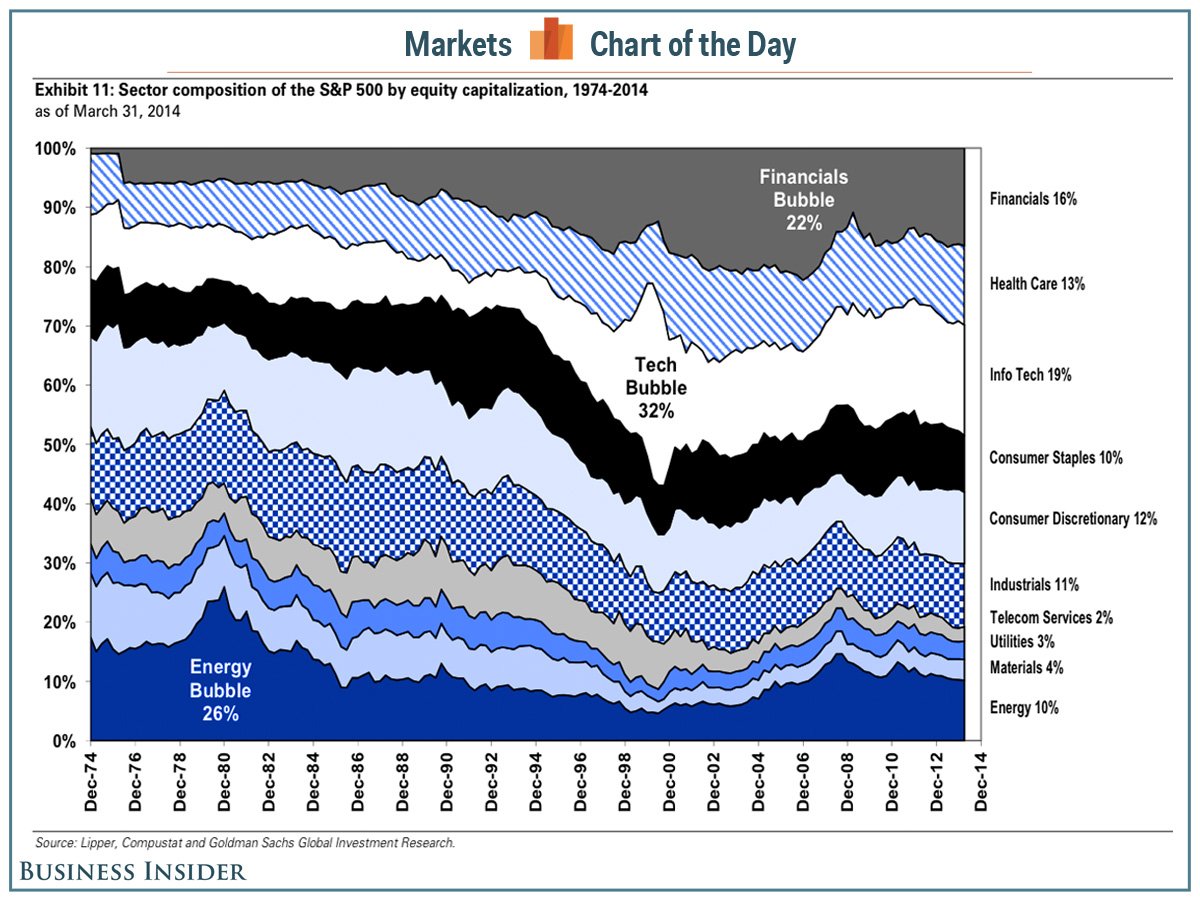
Following is an interesting chart to spot bubbles within the stock market. Any time a sector’s weighting goes above 20%, it could signal trouble ahead. There were three instances since 1974 when the sector weightings for Energy, Technology and Financials exceeded that threshold and cause a bubble.

Sector Composition of the S&P 500 by Equity Capitalization, 1974-2014

What about the Shiller PE Ratio?

By Uncategorized

The strong performance of stocks in 2013 has many commentators describing the current market as being in a bubble. And often they cite the Shiller P/E [price-to-earnings] ratio, a measure developed by Yale economist and Nobel Prize winner Robert Shiller.

As of March 19, 2014, the Shiller P/E stood at 25.4, much higher than the historical average of 16.5. If a value of 16.5 indicates that the market is fairly valued, as some commentators believe, then the current market is more than 50% overvalued. (See Chart below)
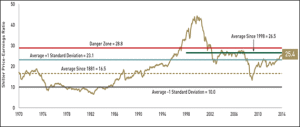
Shiller PE Ratio on S&P 500


The Shiller P/E is a twist on the traditional P/E. It takes the previous 10 years’ earnings on the S&P 500® Index, adjusts them to current dollars, averages them, and then divides this result into the S&P 500’s current market capitalization. By relying on 10 years of earnings, the Shiller P/E mitigates the earnings volatility that can distort the traditional market P/E.

One problem with this measure, however, is that it may be used in a way that is too restrictive. If a reading of over 16.5 means that the market is “overvalued,” then stocks have been “overvalued” for most of the past two decades. Since January 1991, the Shiller P/E has been above average for 268 of the past 278 months.

Yet, during that time, the S&P 500 has more than quintupled, rising from 326.4 (on January 2, 1991) to more than 1,860 (as of March 19, 2014). Including dividends, this amounts to a compound annual return of 10.1%. Clearly, investors using the Shiller P/E in order to avoid an “overvalued” market would have missed out on significant gains.

The Shiller P/E is not, however, without its critics. Wharton professor Jeremy Siegel, for example, has pointed out that the metric may be biased upward because of accounting rule changes made in the late 1990s. These changes require that assets be written down when they lose value and then charged against income. Increases in asset prices, however, are not recorded unless the assets are sold.

These changes create a downward bias in reported GAAP earnings, says Siegel, resulting in an upward bias in the Shiller P/E. Siegel also believes these accounting changes make comparisons of today’s earnings with those reported before the changes invalid. He recommends that for an apples-to-apples comparison with today’s market, only the last 15 years of Shiller P/Es be used. The average over this period (December 1998 to December 2013) is 26.5, further suggesting that current valuations may not be as unreasonable as many suggest.

Those arguing for a market bubble also cite corporate profit margins, which are near record highs and which some believe are likely to return to more normal levels soon. But many factors are behind the higher profitability, including low interest rates and favorable tax rates in international markets, neither of which is likely to change soon.

Operating leverage is also responsible for the improved profits, according to Milton Ezrati, Lord Abbett Partner, Senior Economist and Market Strategist. “The capital intensity of U.S. business enhances productivity, but it also raises fixed costs relative to total costs, and these fixed costs don’t go away during an economic downturn the way employee costs do,” said Ezrati. “Fixed costs must be covered even when revenues decline, so when sales fall, earnings may drop precipitously,” he added. “But when revenues rise, much of the increase goes right to the bottom line, as the fixed costs are covered.”

This positive effect may persist for a while, according to Ezrati. The economy is still using only 78.5% of its existing capacity, according to the Federal Reserve, suggesting that firms still have more equipment to bring online, which would allow even more revenues to flow to the bottom line.

(Source: Lord Abbett)

 

Citi Economic Surprise Index

By Uncategorized

Citi Economic Surprise Index

The Citi Economic Surprise Index tracks actual economic data relative to consensus expectations. When the index is above zero, economic data releases are coming in better than expected, and conversely, readings below zero signal economic data releases are below expectations. Since mid-January, the index has been falling and is now in negative territory, indicating a slowdown in economic activity relative to expectations. Some, but not all, of this weakness can be attributed to the harsh winter weather. However, we could be near a low in this measure as economists begin to incorporate new information into their forecasts.

(Source: Citigroup)