Category

Market Outlook

Fortune: Uninsured depositors remain a ticking time bomb for the U.S. Banking system

By Market Outlook

According to Fortune, 40% of all deposits remain uninsured. Deposit insurance in U.S. banks is provided by the Federal Deposit Insurance Corporation (FDIC); for credit unions, it’s the National Credit Union Administration. The maximum amount covered is $250,000 in a bank account (although there are ways to have multiple covered accounts).  EWM is helping high net worth individual or a business with more than $250,000 in deposits increase their FDIC insurance, through Cantor Fitzgerald’s CF Cash Program. Learn more at EndowmentWM.com/cash.


Fixed Income: How should you invest during rising interest rates?

By Market Outlook

Robert L. Riedl, CPA, CFP®, AWMA®
Director of Wealth Management

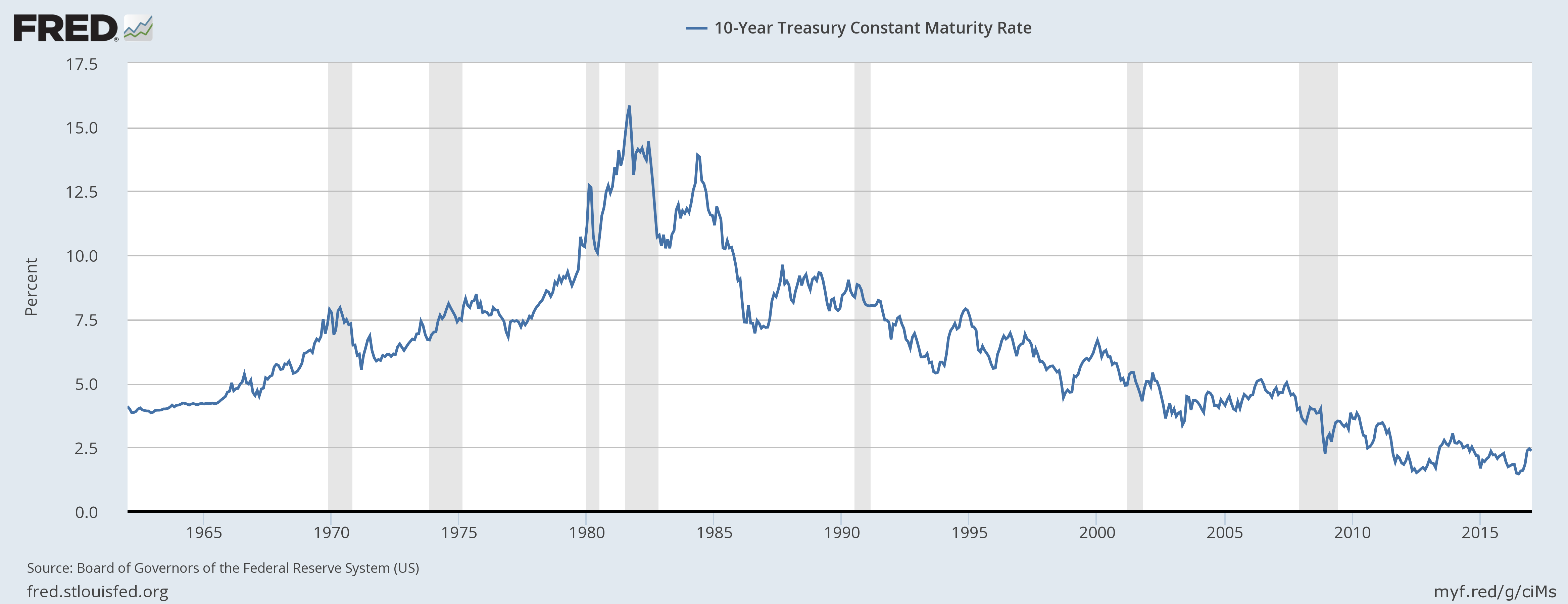
For the past 30 years, the extended period of falling interest rates made long-term US Treasury bonds a great place to be.  However, late last year, indications surfaced that the long-term decline in interest rates may be reversing.  Yields on 10-year US Treasury bonds hit a low of 1.32% on July 6, 2016 and are now at 2.38% (which is still below the historic average rate of over 4%).

For savers that have been earning about 0.2% interest on cash for the last few years, the prospect of rising interest rates is a welcome relief.   However, for investors in bonds, including traditional US Treasury bonds (which have historically been considered conservative investments), rising interest rates should be an alarming situation.

Long Term Interest Rates FRED


Fact:  For every one percentage increase in interest rates, 10-year US Treasury bonds will fall approximately 8.8% and 20-year US Treasury bonds will fall 17.5%!  In comparison, the Barclay Aggregate Bond fund will only fall 5.8% because of its broader diversification and lower duration. Thus, understand the duration or maturity of your bond holdings to properly assess the interest rate risk of your portfolio.

It is possible to mitigate interest rate risk.  For example, substitute your long-term bonds for a stable value fund.  There are fixed income alternatives (which we call satellite investments), to consider that may diversify your fixed income portfolio, such as floating rate debt, high yield bonds, emerging market bonds, inflation-linked bonds, or possibly private credit strategies such as mezzanine debt, middle market debt, venture debt, peer to peer debt, structured credit, or others.

Interest rate risk is not the only risk affecting bonds.  Numerous other factors influence your fixed income allocation, such as credit risk, your personal risk tolerance, and others.   Let us help you understand your fixed income portfolio.  To arrange for your complimentary, no-obligation consultation to review your fixed income portfolio with a fee-based fiduciary adviser at Endowment Wealth Management, contact us today.

Disclaimer: Not intended as individualized investment advice.  All investments involve risk.  Investments not insured, not bank guaranteed and may fluctuate in value.  Diversification does not protect against loss in a declining market.  You should consider your goals, risk tolerance, and the risks and costs of investing before making any investment decision.

ewm-e-logo-tm

Are Emerging Markets coming back for good?

By Market Outlook

Emerging markets (EM), one of the most unloved asset classes of the past few years, have recently proven to be a bright star in the market. As global equities posted another strong week (hitting fresh year-to-date highs across a number of markets), EM continued to strengthen. Its success thus far in 2016 raises a question on an asset class that has struggled for most of the past five years: Is EM finally back?

The EM asset class posted a great first quarter, gaining 5.7%, as measured by the MSCI Emerging Markets Index. Several EM markets did exceptionally well, with the MSCI Latin America and MSCI EM Eastern Europe indices posting advances of +19.1% and +15.0%, respectively. Higher commodity prices, combined with an improving investor risk appetite and dovish global central banks, as well as a weakening dollar, helped to fuel much of the rally. EM’s success this year has been a great trend reversal of losses in the past three calendar years, including a -14.9% decline in 2015.

Its struggles have also negatively affected well-diversified portfolios, which have experienced a rally driven predominantly by US large cap over the past three years. Although we have definitely seen weak years recently for EM, it is important to remember that it can often lead by very wide margins. Over the 10-year decade from 2000-2009, in which the S&P 500 posted a loss of 9.1%, the MSCI Emerging Markets Index gained 154%, easily outpacing most major asset classes.

Despite its struggles of the past few years, strong reasons support owning EM, many of which investors have ignored. From a valuation perspective, MSCI Emerging Markets are trading at a forward P/E of 11.9, compared with 15.6 for the MSCI ACWI Index, and 17 for the S&P 500 Index, and also at a lower relative value from historical levels. From a diversification standpoint, owning EM helps portfolios gain access to countries that are experiencing growth at different times in their economic cycles, and often at higher rates, than the U.S.

Much of the negativity surrounding EM in 2015 was the Federal Reserve’s (Fed) looming rate hikes and the potential negative impact they would have on developing countries. Heading into 2016, the Fed was expected to raise rates four times this year. However, weaker-than-expected global economic data and indications from the Federal Open Market Committee (FOMC) suggest that we are still a ways off from the Fed’s moving aggressively to raise rates.

For the time being, EWM believes EM is definitely back. Whether the trend continues for investors buying into the story of a recently unloved asset class, or we see another reversal out of EM, only time will tell. One thing is certain: EM has posted outstanding gains in the past, often when other asset classes are struggling, and its success may mark the return of diversification.

Is the U.S. stock market fairly valued?

By Market Outlook

As the stock market pulled off another dramatic, V-shape turnaround, and the S&P 500 Index is once again within striking distance of its all-time high, the discussion has intensified as to whether or not the stock market is overvalued. Although valuation is never a good market-timing tool for short-term traders, price does matter, especially for long-term investors.

Much confusion exists on how to value the stock market. Different market commentators use various valuation measures, whether due to their diverse schools of thought or their dissimilar views that support their own interpretation of the market. For example, someone making a strong case for the market being grossly overvalued will use the most conservative earnings measures, such as normalized or inflation-adjusted earnings. On the other hand, those aspiring to convince the public that the market is cheap may rely on more “lenient”, or growth-oriented earnings measures, such as EBITDA or out-year earnings projections.

The stock market, and rightfully so, is the Price-to-NTM (next-twelve-month) consensus earnings estimate. For example, if the S&P 500 Index stands at 2000, and the NTM consensus earnings estimate is $120 per share, the stock market is valued at 16.7 times forward earnings.  This figure is slightly higher than the long-term average of approximately 15 times forward earnings.

Another widely used measure is Price-to-LTM (last-twelve-month) earnings. Since investing in the stock market is based on a company’s future earnings, this backward-looking measure is not considered relevant for decision making.  That is because it generally overstates how expensive the market is, as aggregate corporate earnings generally grow year after year.

It is worth mentioning that NTM consensus earnings are a recurring, pro-forma earnings estimate that excludes one-time items, such as write-downs or write-ups of asset values. These earnings are not strictly compliant with GAAP earnings, and pro-forma numbers do not have a good reputation (as some corporate crooks have abused them to mislead investors). But it is appropriate to use them for a stock market comprising hundreds, if not thousands, of companies, as one-time items of a host of them tend to offset each other, especially over time.

The S&P 500 Index consensus earnings estimate currently stands at $119 per share for 2016, and $135 per share for 2017. At the April 7 close of 2041.91, the Index trades at 17.2 times 2016 consensus earnings estimate. It is no doubt expensive, but if the 2017 estimate of $135 per share holds (+13.4% growth over 2016), the multiple will drop to just 15.1 at year end, based on the Index’s current level, and close to its long-term average. Of course, the consensus earnings estimates for 2016 and 2017 are anything but certain, since they are subject to frequent (if not significant) revisions as the macroeconomic environment evolves and companies update their earnings projections. They are imperfect, moving targets, but they do provide a rough estimate of how cheap or expensive the stock market is.

Why we continue to own Emerging Market Stocks?

By Market Outlook

When we talk about emerging market equities today, we find that people are disappointed: there has been under-performance of late. Additionally, there remain key risks:

• The U.S. Federal Reserve (Fed) raises short-term interest rates
• Commodity prices decline

While each of these well-publicized risks can contribute to further volatility, it’s also quite possible that they are already reflected in emerging market equity valuations today.

Dividend Yield as a Barometer for Valuation Opportunities

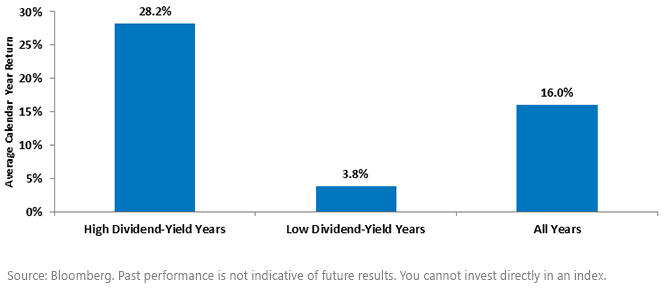
There are many ways to measure equity valuation, and in this case we look at dividend yields. Specifically, we break the available history (starting in 1988) of the MSCI Emerging Markets Index into high- and low-dividend-yield years.

High-Dividend-Yield Years: Years that began with a dividend yield above the median dividend yield for all calendar years.
Low-Dividend-Yield Years: Years that began with a dividend yield below the median dividend yield for all calendar years.
Squarely High Dividend Yields: The median dividend yield was about 2.3% for the full period. 2015 began with a dividend yield of 3.1%1. As of June 30, 2015, the MSCI Emerging Markets Index had a dividend yield of about 3.0%.

The Bottom Line: Since high-dividend-yield years indicate lower prices relative to dividends, the key question is whether they exhibited different returns, on average, than the low-dividend-yield years, when price levels relative to dividends were higher.

Dividend Yield is a Potential Measure of Relative Valuation in Emerging Markets
(12/31/1987 to 6/30/2015)

Div-Yield-is-a-Potential-Measure-of-Relative-Value-in-EM

  • High-Dividend-Yield Years: When a year began with a high dividend yield, the average return for that year was over 28%. In fact, such values were followed by negative years in only five instances, the worst of which was a negative 25% return in 1998.
    Low-Dividend-Yield Years: When a year began with a low dividend yield, the average return for that year was below 4%. Such values were followed by negative years seven times, the worst of which was 2008’s negative 53% return.
    Years That Started with Dividend Yields above 3.0%: Actually, we started 2015 not only with a high dividend yield but with one above 3.0%. There have been only five such years before, and although past performance can never predict future returns, the returns were strong in those years, averaging 58%. The lowest return of any of these years was 2012, when the MSCI Emerging Markets Index was up over 18%.

Is It Time for the Turnaround?

While we strongly believe that emerging markets will come back into favor, it is extremely difficult to predict when this turnaround will occur. There remain very real risks, but the more critical question regards whether the higher dividend yield reflects these risks.

Some things that we’re being particularly watchful of:

  • Stabilization and/or rebound in commodity prices.
  • Further stimulus in China or other activity relating to China’s currency.
  • U.S. Federal Reserve raising short-term interest rates to help people put this in the rear view mirror so that other things can move back into focus. There is concern as to how emerging market currencies might react.

1Refers to 12/31/2014.

Important Risks Related to this Article

Dividends are not guaranteed, and a company’s future ability to pay dividends may be limited. A company currently paying dividends may cease paying dividends at any time.

Investments in emerging, offshore or frontier markets are generally less liquid and less efficient than investments in developed markets and are subject to additional risks, such as risks of adverse governmental regulation and intervention or political developments.

(Source: Wisdomtree Blog)

Janet Yellen’s First Fed Meeting: Forward Guidance

By Market Outlook

HIGHLIGHTS:

  • The Fed announced an additional $10 billion per month in tapering, split evenly between Treasuries and MBS.
  • The Fed dropped its reference to 6.5% as a threshold for when they would hike short-term interest rates and indicated that they would follow a “broad array” of indicators, including “financial developments”.
  • The majority of members of the FOMC still see the first rate hike in 2015, but the pace of rate hikes is projected to be slightly quicker than previously estimated, even though the economic projections were adjusted downward.
  • There was one dissenting vote by Kocherlakota who favored sticking with the unemployment and inflation guidelines.

This was the first meeting for Janet Yellen to preside as Chairwoman, but it is also one with some unfilled seats. While there is plenty of uncertainty with many of the voting members in 2014, we think that the overall composition of the FOMC is likely to be more hawkish this year. While we don’t expect a significant change to current policies in the near term, we think that the changes at the Fed could mean we’ll be hearing differing views in the year ahead.

The Fed’s slower pace of bond buying means that its influence on Treasury yields will continue to decline, while the pace of economic growth and inflation prospects are likely to play a larger role in setting policy. We don’t see the shift from the numerical threshold of 6.5% unemployment to more qualitative information is all that different from the Fed’s previous approach. It allows the Fed more flexibility on policy, but may make it more difficult for investors to assess the Fed’s next steps. Treasury bond yields initially moved higher in reaction to the Fed’s statement, perhaps because of the indication that interest rates might move up more quickly once rate hikes begin. However, in her press conference, Yellen explained that the Fed remains committed to reducing unemployment and keeping inflation in check. All in all, our view is that the Fed is still committed to a “measured” approach to changing policy.

BlackRock Global Survey of Institutional Investors

By Market Outlook

Institutions Are Poised to Increase Real Estate and Real Asset Allocations

Institutions Will Move out of Cash, Growing Role for Hedge Funds and Private Equity

Major institutional investors around the world are poised to increase their allocations to alternative investments, with a bias towards real estate and real assets, during 2014, according to a global survey of institutions conducted by BlackRock.

Approximately half of institutions surveyed– 49 percent – expect to increase their real estate allocation and over 40 percent indicated they will increase their investment in real assets this year. At the same time, about one-third of the institutional investors surveyed intend to reduce their cash holdings in 2014.

“Institutional investors are seeking to build portfolios better suited for an investment landscape characterized by low yields, sluggish growth, volatile markets, and rising correlation between stocks and bonds,” said Robert Goldstein, Senior Managing Director and head of BlackRock’s Institutional Client Business and BlackRock Solutions.

“Divergent economic and geopolitical conditions globally offer institutions a menu of real estate and real asset opportunities that meet a variety of investment objectives,” said Goldstein.

“In real estate, while core, income producing investments in developed markets are still in favor because of their liquidity and safe cash flows, we anticipate that institutions looking for income-producing alternatives will turn their attention to more opportunistic real estate investments outside their home markets,” said Goldstein.

“We’re also seeing a growing interest in infrastructure debt. These types of investments can potentially offer institutions high fixed yields, with stable cash flows and long duration.”

Seeking Out Better “Portfolio Buffers”

“The results of the survey likely reflect a recognition that, going forward, the portfolio diversification benefit traditionally offered by equities and bonds might be less powerful than in the past,” Goldstein said. “Indeed, the price correlation between US equities and bonds, which had been negative from 2009 through mid-2013, has been positive ever since then – suggesting that institutions definitely will be looking to other asset classes for more effective ‘portfolio buffers’ in coming months.”

A Growing Interest in Hedge Funds and Private Equity

“Within the alternatives category, we believe hedge funds and private equity also will command a growing role in institutional portfolios in 2014, with investors casting a wide net for appropriate diversification tools,” said Goldstein.

Nearly 30 percent of institutions surveyed intend to increase their hedge fund allocations this year.

In the Americas, over 40 percent of institutions are likely to increase their hedge fund allocation; none is planning a decrease. The trend is less true for EMEA, where 35 percent of institutions intend to allocate less to hedge funds and just 20 percent will allocate more.

Approximately one-third of institutions surveyed anticipate allocating more to private equity. Private equity is less popular with EMEA institutions and smaller investors (those with less than $20 billion in AUM), with these investors indicating they will either maintain or reduce current private equity allocations.

About the Survey

BlackRock surveyed approximately 100 institutional investors representing the firm’s Americas, Europe/Middle East/Africa (EMEA), and Asia-Pacific (APAC) markets, including corporate and private pension funds, insurers, investment managers, and government entities. In total, the investors surveyed represent more than $6 trillion in assets under management (AUM), with an average AUM of $70 billion.

About BlackRock

BlackRock is a leader in investment management, risk management and advisory services for institutional and retail clients worldwide. At December 31, 2013, BlackRock’s AUM was $4.324 trillion. BlackRock helps clients meet their goals and overcome challenges with a range of products that include separate accounts, mutual funds, iShares® (exchange-traded funds), and other pooled investment vehicles. BlackRock also offers risk management, advisory and enterprise investment system services to a broad base of institutional investors through BlackRockSolutions®. Headquartered in New York City, as of December 31, 2013, the firm had approximately 11,400 employees in more than 30 countries and a major presence in key global markets, including North and South America, Europe, Asia, Australia and the Middle East and Africa. For additional information, please visit the Company’s website at www.blackrock.com.

Disclaimer

This material represents an assessment of the market environment at a specific time and is not intended to be a forecast of future events or a guarantee of future results. This information should not be relied upon by the reader as research or investment advice. Investing in alternative investments involves higher risks than traditional investments and may not be suitable for all investors. Alternative investments may be highly leveraged and engage in speculative investment techniques, which an magnify the potential for investment loss or gain.

BlackRock® is a registered trademark of BlackRock, Inc. All other trademarks are the property of their respective owners.

 

Will the 2013 Equity Rally Repeat in 2014?

By Market Outlook

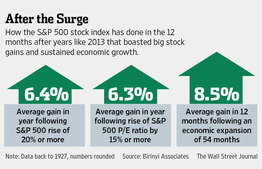
History seems to support the idea that 2014 will be less historic than 2013. Since 1927, there have been 23 years in which the S&P 500 has risen 20% or more, according to Birinyi Associates. It averaged a further gain of 6.4% in the next year. That is only slightly better than the 5.5% gain the S&P averaged for all years since 1927.

On only one of those 23 occasions of 20%-plus annual gains did the S&P improve its performance in the following year. In 1997 it rose 31% after a 20% gain in 1996. It rose again in 1998, by 27%, and in 1999, by 20%. Those were the days.

The S&P 500 has been known to decline in the year after a 20% gain. That has happened eight times. Six times it put in another 20% gain.

Data comparing the expansion of the S&P 500’s price/earnings ratio with past years, and comparing the performance at the current stage in the economic cycle, suggest gains of 6% to 9%.

It is possible that 2014 will be another year like 1997 and stocks will rise even faster than in 2013. Many in the market think the new Fed chairwoman, Janet Yellen, slated to take office Feb. 1 pending Senate confirmation, will delay withdrawing stimulus and fuel another big market year.

But before betting that 2014 will be better than 2013, investors might consider that it has happened once since 1927.

After the Surge-WSJ

(Source: Wall Street Journal)

Morgan Stanley’s 10 Big Macro Investment Ideas For 2014

By Market Outlook

Morgan Stanley’s Global Strategy team is out with its 2014 outlook titled: Fertile Soils, Rising Divergences.

In it, Morgan Stanley says that they generally favor stocks over bonds, but that we’re now in the second half of this big boom, and that future gains will now depend more on growth, as opposed to liquidity.

This is a similar idea as that expressed by Nomura, which argued that the end of “end of the world risk” would require a search for real growth, rather than just gains brought on by climbing out of the gutter.

Here are Morgan Stanley’s 10 big macro strategy ideas:

— European Equities: Long Financials (SX7P, SXIP); Short Cyclicals (SXNP, SXPP, SX4P)

— Asia Equities: Long Nikkei, HSCEI, Kospi, Taiex; Short CNX Nifty, JCI, SET, FBMKLCI, FSSTI

— US equities: Healthcare over Staples; Tech over Discretionary; Chemicals over Industrials and Energy

— Long US credit versus European Credit (Long US CDX HY versus Short iTraxx XOver)

— Long USD interest rate volatility (Long 2y10y swaption straddles)

— Long Spain over Italy sovereign bonds (10y Bonos versus BTPs)

— Long US IG long-duration discount bonds versus UST

— Short EM sovereign credit (Short EM CDX)

— Long new-issue CLO equity

— Long USDJPY, Long USDRUB

Goldman Sachs Top Ten Market Themes for 2014

By Market Outlook

The 10 points “represent a broad list of macro themes from our economic outlook that we think will dominate markets in 2014.”

Here they are, with the key quotes pulled from the note.

1. Showtime for the US/DM Recovery

Our 2013 outlook was dominated by the notion that underlying private- sector healing in the US was being masked by significant fiscal drag. As we move into 2014 and that drag eases, we expect the long-awaited shift towards above-trend growth in the US finally to occur, spurred by an acceleration in private consumption and business investment.

2. Forward guidance harder in an above-trend world

Despite the improvement in growth, we expect G4 central banks to continue to signal that rates are set to remain on hold near the zero bound for a prolonged period, faced with low inflation and high unemployment. In the US, our forecast is still for no hikes until 2016 and we expect the commitment to low rates to be reinforced in the next few months.

3. Earn the DM equity risk premium, hedge the risk

Over the past few years, we have seen very large risk premium compression across a wide range of areas. While not at 2007 levels, credit spreads have narrowed to below long-term averages and asset market volatility has fallen. Even in a friendly growth and policy environment such as the one we anticipate, this is likely to make for lower return prospects (although more appealing in a volatility-adjusted sense). In equities, in particular, the key question we confront is whether a rally can continue given above-average multiples. We think it can.

4. Good carry, bad carry

Our 2014 forecast of improving but still slightly below-trend global growth and anchored inflation describes an environment in which overall volatility may justifiably be lower. Markets have already moved a long way in this direction, but equity volatility has certainly been lower in prior cycles and forward pricing of volatility is still firmly higher than spot levels. In an environment of subdued macro volatility, the desire to earn carry is likely to remain strong, particularly if it remains hard to envisage significant upside to the growth picture.

5. The race to the exit kicks off

2013 has already seen some EM central banks move to policy tightening. As the US growth picture improves – and the pressure on global rates builds – the focus on who may tighten monetary policy is likely to increase. As we described recently (Global Economics Weekly 13/33), the market is pricing a relatively synchronised exit among the major developed markets, even though their recovery profiles look different. Given that the timing of the first hike has commonly been judged to be some way off, this lack of differentiation is not particularly unusual. But the separation of those who are likely to move early and those who may move later is likely to begin in earnest in 2014.

6. Decision time for the ‘high-flyers’

A number of smaller open economies have imported easy monetary policy from the US and Europe in recent years, in part to offset currency strength and in part to compensate for a weaker external environment. In a number of these places (Norway, Switzerland, Israel, Canada and, to a lesser extent, New Zealand and Sweden), house prices have appreciated and/or credit growth has picked up. Central banks have generally tolerated those signs of emerging pressure given the external growth risks and the desire to avoid currency strength through a tighter policy stance. As the developed market growth picture improves, some of these ‘high flyers’ may reassess the balance of risks on this front.

7. Still not your older brother’s EM…

2013 has proved to be a tough year for EM assets. 2014 is unlikely to see the same level of broad-based pressure. The combination of a sharp downgrade to expectations of China growth and risk alongside the worries about a hawkish Fed during the summer ‘taper tantrum’ are unlikely to be repeated with the same level of intensity.

8. …but EM differentiation to continue

2013 saw countries with high current account deficits, high inflation, weak institutions and limited DM exposure punished much more heavily than the ‘DMs of EMs’, which had stronger current accounts and institutions, underheated economies and greater DM exposure. This is still likely to be the primary axis of differentiation in coming months, but in 2014 we would also expect to see greater differentiation within both these categories.

9. Commodity downside risks grow

Last year we pointed to the ongoing shift in our commodity views, ultimately towards downside price risk. The impact of supply responses to the period of extraordinary price pressure continues to flow through the system. And we are forecasting significant declines (15%+) through 2014 in gold, copper, iron ore and soybeans. Energy prices clearly matter most for the global outlook. Here our views are more stable, although downside risk is growing over time and production losses out of Libya/Iran and other geopolitical risk is now playing a large role in keeping prices high.

10. Stable China may be good enough

Expectations of Chinese growth have reset meaningfully lower as some of the medium-term problems around credit growth, shadow financing and local governance have been widely recognised over the past year. Some of these issues continue to linger: the risks from the credit overhang remain and policymakers are unlikely to be comfortable allowing growth to accelerate much. But the deep deceleration of mid-2013 has reversed and even our forecast of essentially flat growth (of about 7.5%) may be enough to comfort investors relative to their worst fears.