All Posts By

EWM Team

Fixed Income: How should you invest during rising interest rates?

By Market Outlook

Robert L. Riedl, CPA, CFP®, AWMA®
Director of Wealth Management

For the past 30 years, the extended period of falling interest rates made long-term US Treasury bonds a great place to be.  However, late last year, indications surfaced that the long-term decline in interest rates may be reversing.  Yields on 10-year US Treasury bonds hit a low of 1.32% on July 6, 2016 and are now at 2.38% (which is still below the historic average rate of over 4%).

For savers that have been earning about 0.2% interest on cash for the last few years, the prospect of rising interest rates is a welcome relief.   However, for investors in bonds, including traditional US Treasury bonds (which have historically been considered conservative investments), rising interest rates should be an alarming situation.
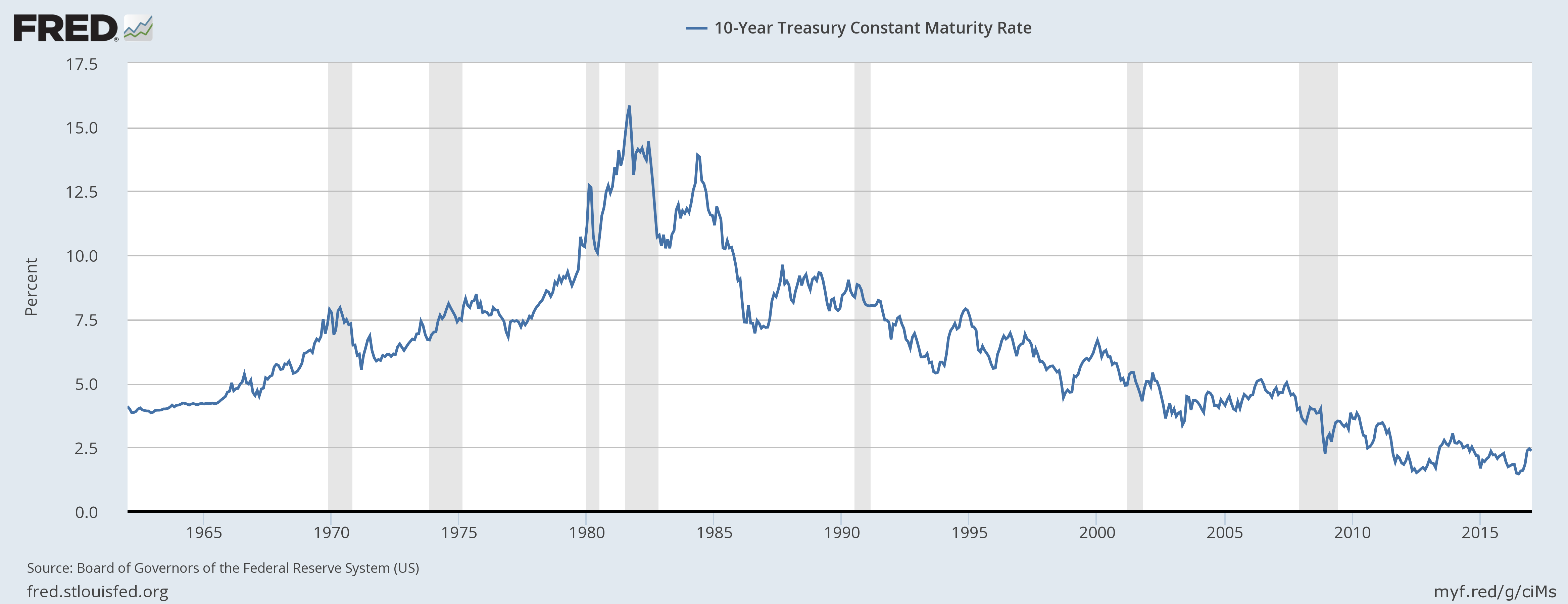
Long Term Interest Rates FRED


Fact:  For every one percentage increase in interest rates, 10-year US Treasury bonds will fall approximately 8.8% and 20-year US Treasury bonds will fall 17.5%!  In comparison, the Barclay Aggregate Bond fund will only fall 5.8% because of its broader diversification and lower duration. Thus, understand the duration or maturity of your bond holdings to properly assess the interest rate risk of your portfolio.

It is possible to mitigate interest rate risk.  For example, substitute your long-term bonds for a stable value fund.  There are fixed income alternatives (which we call satellite investments), to consider that may diversify your fixed income portfolio, such as floating rate debt, high yield bonds, emerging market bonds, inflation-linked bonds, or possibly private credit strategies such as mezzanine debt, middle market debt, venture debt, peer to peer debt, structured credit, or others.

Interest rate risk is not the only risk affecting bonds.  Numerous other factors influence your fixed income allocation, such as credit risk, your personal risk tolerance, and others.   Let us help you understand your fixed income portfolio.  To arrange for your complimentary, no-obligation consultation to review your fixed income portfolio with a fee-based fiduciary adviser at Endowment Wealth Management, contact us today.

Disclaimer: Not intended as individualized investment advice.  All investments involve risk.  Investments not insured, not bank guaranteed and may fluctuate in value.  Diversification does not protect against loss in a declining market.  You should consider your goals, risk tolerance, and the risks and costs of investing before making any investment decision.

ewm-e-logo-tm

2016 Year End High Yield Default Rates

By Uncategorized

Moody’s reported that its global speculative-grade default rate stood at 4.4% at the end of Q4’16, according to its own release. It sees the rate falling to 3.0% by December 2017. Moody’s puts the historical average default rate at 4.2% since 1983. In 2016, the number of defaults totaled 142, the highest amount since 2009. The U.S. speculative-grade default rate stood at 5.6% at the end of Q4’16. It sees the U.S. rate falling to 3.8% by December 2017. The default rate on senior loans stood at 2.06% in December, according to S&P Global Market Intelligence.

Data Never Sleeps

By General

Data is exploding faster than our ability to put our arms around it, so you’re going to have to adapt. The right answer on Monday is never going to be the right answer on Tuesday. General Stanley McChrystal.

16_domo_data-never-sleeps-4https://www.domo.com/blog/data-never-sleeps-4-0/

A Macro View – Election Impact on International Equity Markets

By Uncategorized

After struggling in recent years, international equity markets have been performing well so far this year. Year to date, as of September 29th, developed equity markets, as measured by the MSCI EAFE Index, gained nearly 3%, despite all the problems ranging from negative interest rates to Brexit. Emerging markets equities, as measured by the MSCI Emerging Market Index, did even better, jumping nearly 18%, far exceeding the 7% gain of the S&P 500 Index. However, international equities are facing a huge test: the upcoming US presidential election. Although these markets deal with this every four years, the stakes are even higher this year due to the unique characteristics of the two candidates.


Mr. Trump, the Republican Party nominee, has almost made this US election all about unfair international trade—unfair trade has caused job loss in the US, unfair trade has caused huge national debt, and unfair trade has made the US not so great. Apparently, if Mr. Trump wins, and follows through with his anti-trade election rhetoric, international equity markets will be affected, as a number of countries still rely heavily on exports to the US to grow their economies. However, potentially more damaging and less dramatized by the media is his anti-Federal Reserve (Fed) rhetoric, and he truly may mean it. Mr. Trump shares a quite popular view among many that the Fed is too political, keeps interest rates too low for too long, and is creating a huge asset bubble that is bound to burst. If he becomes the next president, and rushes to reverse Fed policy in his “Trump” style, interest rates could potentially jump and the dollar could surge. Whereas the sudden change and chaos may affect financial markets worldwide, emerging markets are likely to be hit the hardest. Currency values of many emerging markets countries are somewhat pegged to the US dollar, and some of them use the US dollar as their currency outright, without bothering to issue their own currency. As a result, their monetary policies are highly dictated by the Fed, and for some, the Fed is essentially their central bank as well. A sudden rise in both US interest rates and the dollar means monetary policies can tighten quickly, a shock that few emerging markets economies, (which tend to have relatively fragile financial systems), can handle.


Ms. Clinton, the Democratic Party nominee, is a status-quo candidate, and the status-quo, while not ideal for all stakeholders of the economy, has been great for most investors in recent years. As the former First Lady, US Senator, and Secretary of State, Ms. Clinton may have greater insight into the international situation, and she is also a more familiar figure to leaders of other countries. From this familiarity perspective alone, Ms. Clinton may be less of a risk than Mr. Trump for international equity markets. The TPP (Trans-Pacific Partnership) is so far about the only thing in which Ms. Clinton differs from President Obama, as she has switched from supporting to opposing TPP when her presidential campaign started. She may very well switch back if and when she becomes president. TPP is not really a giveaway from the US to other countries, and so far only 12 countries are included in the deal (China is not even part of it). There should be limited damage to the international equity markets if TPP is revoked.

Interest Rates and the Stock Market

By Uncategorized

Correlations can be a misleading measure of the interaction between economic variables. Here, we take a look at interest rates and the stock market.

Consider the cause-and-effect chains that exist between the economy, interest rates, and the stock market. Economic growth should in general be good news for the stock market, and it should also generally mean upward pressure on interest rates. A weak economy should be the opposite.

However, the stock market tends to welcome news of a cut in rates, and dislike increases.

This creates a slightly complex picture as regards the interaction between interest rates and the stock market. On the one hand, the direct connection might be expected to lead to a negative correlation; falling rates being good for markets. On the other hand, the way that the broader economic picture affects each would point to a positive correlation; when the economy is strong, we expect rising rates and strong markets.

In isolation, a rate increase can be seen as bad news for the market, but as a symptom of a strong economy it can be seen as good news. These relationships aren’t really that confusing, but they become so if we try to reduce them to a single correlation number.

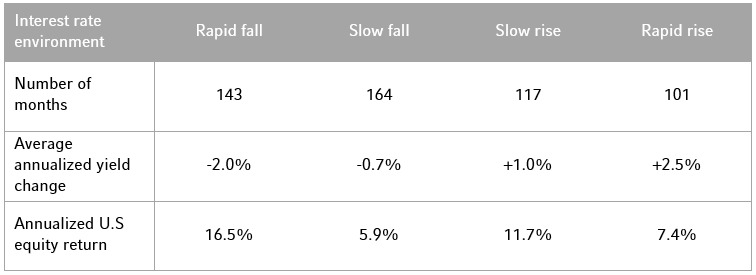
Evidence of the nuanced relationship can be found in historical returns patterns as shown in the table below:  U.S equities did well when rates rose slowly (i.e. rate less than 1% per year), but not so well when rates rose rapidly (perhaps because rapid increases are often associated with economic distress); meanwhile, when rates fell, U.S. equities did better when they fell rapidly, and not so well when they fell slowly.

Annualized returns on U.S. equities in different interest rate environments (This analysis covered the period January 1970-September 2013).

Source: Russell Investments (Madden & Totten (2014) When rates rise, do stocks fall?)

U.S. Equity Returns in Different Interest Rate Environments

Are Emerging Markets coming back for good?

By Market Outlook

Emerging markets (EM), one of the most unloved asset classes of the past few years, have recently proven to be a bright star in the market. As global equities posted another strong week (hitting fresh year-to-date highs across a number of markets), EM continued to strengthen. Its success thus far in 2016 raises a question on an asset class that has struggled for most of the past five years: Is EM finally back?

The EM asset class posted a great first quarter, gaining 5.7%, as measured by the MSCI Emerging Markets Index. Several EM markets did exceptionally well, with the MSCI Latin America and MSCI EM Eastern Europe indices posting advances of +19.1% and +15.0%, respectively. Higher commodity prices, combined with an improving investor risk appetite and dovish global central banks, as well as a weakening dollar, helped to fuel much of the rally. EM’s success this year has been a great trend reversal of losses in the past three calendar years, including a -14.9% decline in 2015.

Its struggles have also negatively affected well-diversified portfolios, which have experienced a rally driven predominantly by US large cap over the past three years. Although we have definitely seen weak years recently for EM, it is important to remember that it can often lead by very wide margins. Over the 10-year decade from 2000-2009, in which the S&P 500 posted a loss of 9.1%, the MSCI Emerging Markets Index gained 154%, easily outpacing most major asset classes.

Despite its struggles of the past few years, strong reasons support owning EM, many of which investors have ignored. From a valuation perspective, MSCI Emerging Markets are trading at a forward P/E of 11.9, compared with 15.6 for the MSCI ACWI Index, and 17 for the S&P 500 Index, and also at a lower relative value from historical levels. From a diversification standpoint, owning EM helps portfolios gain access to countries that are experiencing growth at different times in their economic cycles, and often at higher rates, than the U.S.

Much of the negativity surrounding EM in 2015 was the Federal Reserve’s (Fed) looming rate hikes and the potential negative impact they would have on developing countries. Heading into 2016, the Fed was expected to raise rates four times this year. However, weaker-than-expected global economic data and indications from the Federal Open Market Committee (FOMC) suggest that we are still a ways off from the Fed’s moving aggressively to raise rates.

For the time being, EWM believes EM is definitely back. Whether the trend continues for investors buying into the story of a recently unloved asset class, or we see another reversal out of EM, only time will tell. One thing is certain: EM has posted outstanding gains in the past, often when other asset classes are struggling, and its success may mark the return of diversification.

Today is the 10 year anniversary of the First Trust U.S. IPO ETF (FPX)

By ETF Related

At Endowment Wealth Management we have been recommending and using the above ETF since inception within our Private Equity and Risk Managed Models. We use this ETF as a proxy for public private equity, as these are considered newly listed. We are pleased with this ETF completing it’s 10 year of existence. Moreover, the performance over that time period has been impressive as well.

The IPOX 100 U.S. Index (that underlies this ETF) currently pools a total market capitalization of approximately USD 1.3 trillion. Since inception, the USD 585 milion ETF has returned +169.14% vs. +96.66% and +69.26% for the ETFs linked to the S&P 500 (SPY) Index and Russell 2000 (IWM) Index, respectively. The fund carries a 5 star rating from Morningstar.

The ETF tracks IPOX Schuster’s IPOX 100 U.S. Index (IPXO), benchmark for the largest and typically best performing U.S. IPOs and corporate Spin-offs “going public” over a 4-year rotational cycle. IPOX Schuster LLC (www.ipoxschuster.com), the Chicago-based innovative Financial Services Firm specializing in Financial Products Design related to Newly listed companies such as IPOs and corporate Spin-offs, is the creator and managed of this Index.


Is the U.S. stock market fairly valued?

By Market Outlook

As the stock market pulled off another dramatic, V-shape turnaround, and the S&P 500 Index is once again within striking distance of its all-time high, the discussion has intensified as to whether or not the stock market is overvalued. Although valuation is never a good market-timing tool for short-term traders, price does matter, especially for long-term investors.

Much confusion exists on how to value the stock market. Different market commentators use various valuation measures, whether due to their diverse schools of thought or their dissimilar views that support their own interpretation of the market. For example, someone making a strong case for the market being grossly overvalued will use the most conservative earnings measures, such as normalized or inflation-adjusted earnings. On the other hand, those aspiring to convince the public that the market is cheap may rely on more “lenient”, or growth-oriented earnings measures, such as EBITDA or out-year earnings projections.

The stock market, and rightfully so, is the Price-to-NTM (next-twelve-month) consensus earnings estimate. For example, if the S&P 500 Index stands at 2000, and the NTM consensus earnings estimate is $120 per share, the stock market is valued at 16.7 times forward earnings.  This figure is slightly higher than the long-term average of approximately 15 times forward earnings.

Another widely used measure is Price-to-LTM (last-twelve-month) earnings. Since investing in the stock market is based on a company’s future earnings, this backward-looking measure is not considered relevant for decision making.  That is because it generally overstates how expensive the market is, as aggregate corporate earnings generally grow year after year.

It is worth mentioning that NTM consensus earnings are a recurring, pro-forma earnings estimate that excludes one-time items, such as write-downs or write-ups of asset values. These earnings are not strictly compliant with GAAP earnings, and pro-forma numbers do not have a good reputation (as some corporate crooks have abused them to mislead investors). But it is appropriate to use them for a stock market comprising hundreds, if not thousands, of companies, as one-time items of a host of them tend to offset each other, especially over time.

The S&P 500 Index consensus earnings estimate currently stands at $119 per share for 2016, and $135 per share for 2017. At the April 7 close of 2041.91, the Index trades at 17.2 times 2016 consensus earnings estimate. It is no doubt expensive, but if the 2017 estimate of $135 per share holds (+13.4% growth over 2016), the multiple will drop to just 15.1 at year end, based on the Index’s current level, and close to its long-term average. Of course, the consensus earnings estimates for 2016 and 2017 are anything but certain, since they are subject to frequent (if not significant) revisions as the macroeconomic environment evolves and companies update their earnings projections. They are imperfect, moving targets, but they do provide a rough estimate of how cheap or expensive the stock market is.

Quotes of the Day

By Quotes

Daniel Kahneman

It’s frightening to think that you might not know something, but more frightening to think that, by and large, the world is run by people who have faith that they know exactly what’s going on.

Mark Twain

It ain’t what you don’t know that gets you into trouble. It’s what you know for sure that just ain’t so.